You’ve noticed the shift: your 10-year-old is no longer satisfied with simple blocks, and the pull of the digital world—social media, gaming, and endless videos—is stronger than ever. This is the age of transition, where children crave independence but still need guidance. If you’re searching for meaningful non-screen activities for 10 year olds that truly engage their maturing minds, you are looking for the key to unlocking their identity and executive function skills. This guide is your blueprint for moving beyond simple distraction to fostering long-term passions, social competency, and deep focus through challenging, real-world, screen-free projects.
Quick Take: The Tween Motivation Shift 🧠
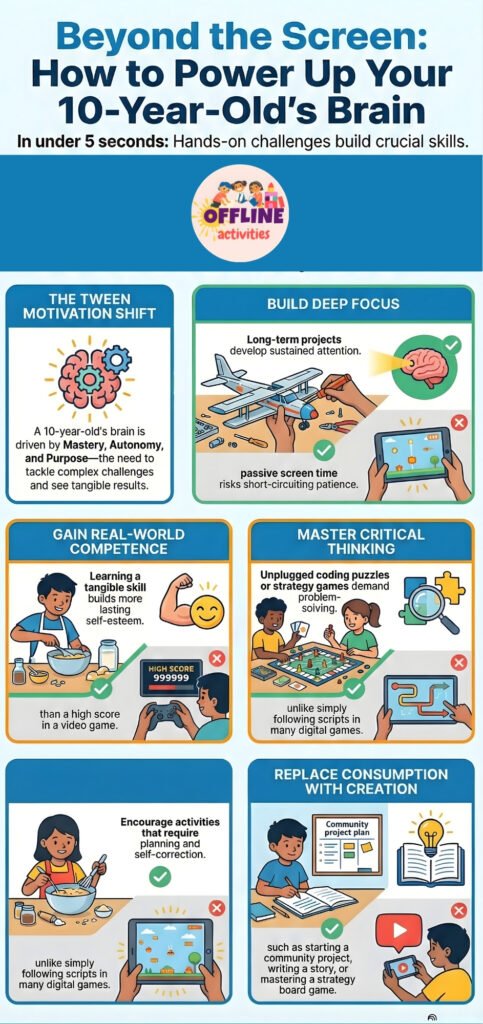
The motivation for a 10-year-old is rooted in Mastery, Autonomy, and Purpose. Non-screen activities for 10 year olds must offer complex challenges with tangible, visible results—like coding logic, building a detailed model, or leading a community project. These hands-on, multi-layered activities are essential for developing the executive function skills required for middle school success, including planning, sustained attention, and frustration tolerance. Our strategy is focused on replacing passive consumption with active, self-directed creation.
Part 1: Why Non-Screen Activities Are Vital for Tween Development
The 9–12 age range is marked by intense growth in the prefrontal cortex, the area responsible for complex thought, risk assessment, and identity formation. Screens, which offer constant comparison and pre-packaged content, can interfere with the essential process of self-discovery and independent critical thinking.
The Rise of Executive Function and Deep Work 💡
For a 10-year-old, the focus shifts from learning how to play to learning how to plan.
- Expert Insight: Executive Function: Psychologists emphasize that tweens need to practice “deep work”—activities that require sustained, uninterrupted focus for 30 minutes or more. The complexity of digital games often disguises an underlying lack of necessity for genuine planning. Offline activities, such as building a complex model kit or writing an original short story, demand self-correction and multi-step planning, which directly strengthens the pathways for long-term goal setting.
- Neurological Perspective: Providing frequent, highly rewarding digital inputs risks short-circuiting the neural systems responsible for patience and delayed gratification. By engaging in hands-on projects, tweens learn to manage the frustration of complexity, leading to greater resilience and improved child focus without screens.
Social Identity and Real-World Competence 🤝
At this age, peers and social acceptance become paramount. Non-screen activities that involve collaboration, leadership, or skill acquisition provide social currency that is real, stable, and confidence-building.
- Real-World Observation: When tweens learn to cook a dinner for the family or successfully fix a bicycle tire, they gain a tangible sense of competence that far outweighs a high score in a video game. This mastery fuels self-esteem and provides a positive focus for their emerging sense of identity.
| Offline Activities (9-12) | Digital Consumption (Passive) | Key Developmental Benefit |
|---|---|---|
| Long-Term Projects (3-week build) | Instant-Access Entertainment | Sustained Attention & Goal Setting |
| Coding Logic (Physical Robotics, Puzzles) | Gameplay (Following Scripts) | Critical Thinking & Abstract Problem-Solving |
| Collaborative Game (Strategy Board Games) | Solitary Social Media Scrolling | Negotiation & Real-Time Social Skills |
| Real-World Skills (Cooking, Repairing) | Virtual Rewards | Self-Efficacy & Future Independence |
Part 2: The Core Toolkit: Projects That Fuel Mastery and Autonomy 🛠️
To effectively encourage fun non-screen activities for 10 year olds, the materials must respect their maturity, inviting complexity and independence.
Strategic Thinking: Logic and Board Games ♟️
Board games move beyond simple luck to demand strategy, patience, and social negotiation—all essential skills for a 10-year-old.
Activity: Mastering a Complex Strategy Game 🏰
Introduce games that require forward-planning, resource management, and negotiation, such as Catan, Ticket to Ride, or Carcassonne.
- Prep: Dedicate a specific evening (e.g., “Strategy Thursday”) to the game, ensuring the environment is calm and free from interruption.
- The Learn: Have the 10-year-old be the “Rules Master.” They must read the instructions and teach the family how to play. This reinforces comprehension and leadership.
- Actionable Tip: Don’t let them win easily. Allow them to feel the sting of a failed strategy, then discuss why it failed. This is crucial practice for frustration tolerance and critical analysis.
- Educational Value: These activities promote systems thinking—understanding how different parts of a system interact—which is fundamental to science and large-scale problem-solving. It’s the ultimate child focus improvement without screens for this age group.
Building Real-World Competence: Culinary Arts 🧑🍳
Cooking moves abstract math (fractions, ratios) into a tangible, delicious result, connecting competence directly to a rewarding outcome.
Activity: The Weeknight Meal Challenge 🍕
- Prep: Start with simple, measurable recipes (pancakes, tacos, simple salads).
- The Ownership: Give the 10-year-old full responsibility for one component of the family dinner, from reading the recipe and measuring ingredients to plating the finished dish.
- Actionable Tip: Introduce a budgeting challenge. Give them $10 and the task of planning and finding the ingredients for a simple dessert at the grocery store. This links math, responsibility, and independence.
- Teacher Insight (E-E-A-T): “When a tween is placed in a real-world scenario—like calculating ingredient costs or following assembly instructions for furniture—their engagement often skyrockets because the stakes are real. This practical application of math and literacy is the definition of motivated, hands-on learning.”
Creative Play Ideas for Children (Ages 9-12) 🎨
Creativity for tweens shifts from expressive art (like finger painting) to skilled craftsmanship and artistic storytelling.
Skilled Arts and Detailed Craftsmanship 🧵
This age group thrives on complexity and the ability to produce something aesthetically refined.
Activity: Advanced Model Making or Needlework 🧶
- Materials: Invest in detailed model kits (planes, cars, architecture) that require painting, gluing, and precision. Alternatively, introduce knitting, crochet, or intricate loom weaving.
- The Process: These projects take time—often weeks or months. Encourage them to set aside a specific time each day (30-45 minutes) and focus solely on the task.
- Actionable Tip: Teach them the importance of specialized tools (e.g., tiny brushes, magnification). The pride in using professional tools elevates the activity’s status.
- Educational Value: This dramatically refines fine motor skills and hand-eye coordination, which is critical even in the digital age. The sustained effort required to complete a complex model builds the patience and perseverance necessary for academic challenges.
Storytelling and Role-Playing for Social Growth 🎭
Dramatic play evolves into complex writing and collaborative world-building.
Activity: Collaborative Dungeon Master or Playwriting 🖋️
- The Scene: Encourage your child and their friends to create an original role-playing game (like Dungeons & Dragons or a simpler storytelling system). The 10-year-old can be the Game Master, responsible for writing the plot, setting the rules, and managing conflicts.
- Actionable Tip: Provide dedicated notebooks, graph paper, and colored pencils for map drawing and character sheets. They are learning narrative structure, world-building, and conflict resolution by creating the rules of their own social world.
- Long-tail Keyword Use: This is an ideal fun non-screen activity for 10 year olds because it naturally integrates social bonding, leadership training, and literacy in a format they control.
Part 4: Integrating Advanced Skills and Real-World Non-Screen Activities 🌳
To keep 10-year-olds motivated, the activities must connect to their future or their community.
STEM Skills: Hands-On Learning in Action ⚙️
Coding logic doesn’t require a screen; it requires pattern recognition, sequence mapping, and troubleshooting.
Activity: Introduction to Electrical Circuits and Robotics Logic 🤖
- Materials: Purchase simple, safe circuit kits (like Snap Circuits) or beginner robotics kits that use physical coding blocks or instructions (like unplugged coding games).
- The Challenge: Give them the manual and let them work through the circuit designs independently. When a circuit fails, guide them through debugging (finding the fault in the sequence).
- Educational Value: This is a pure exercise in logical sequencing and troubleshooting. The immediate, tangible failure (the light doesn’t turn on) is the best motivator to review the plan and try again, cementing abstract programming concepts.
Community Engagement and Purpose 🌎
Tweens seek purpose. Activities that benefit others boost their self-worth and social awareness.
Activity: Community Service Project or Skill Teaching 🤝
- The Project: Help them identify a small local need (e.g., making dog toys for a local shelter, painting rocks to hide in a park, or organizing a book swap).
- The Role: The 10-year-old should be the project manager. They write the plan, gather the materials, and lead the execution.
- Actionable Tip: This provides crucial experience in civic responsibility and organization. They learn that their efforts have a measurable impact outside of themselves, which is a powerful motivator for this age.
Part 5: Establishing Screen-Free Parenting Tips for Tweens 🏡
Motivating a 10-year-old requires mutual respect, not policing. Parenting without devices involves modeling boundaries and respecting their need for privacy and downtime.
The Intentional Environment: A Designated ‘Maker Space’ 🖼️
The 10-year-old needs a workspace that is theirs, where long-term projects can be left undisturbed.
| Area | Supplies to Store | Boundary Rule |
|---|---|---|
| The Maker Space | Complex model parts, soldering iron (with supervision), tools, art supplies. | Respect: Projects remain untouched. This fosters a sense of ownership and sustained work ethic. |
| The Social Hub | Strategy board games, card decks, writing notebooks, collaborative project materials. | Devices off during scheduled game time. (Prioritizes real-time connection). |
| The Personal Retreat | Physical books, journals, musical instruments, drawing pads. | Privacy: This space is for quiet decompression and self-reflection, crucial for identity building. |
Modeling Respect and Digital Hygiene 📵
Your tween is watching your relationship with your devices closely.
- The Digital Negotiation: Instead of simply declaring rules, involve your 10-year-old in the creation of a “Family Digital Wellness Contract.” Discuss why boundaries are important (e.g., “So we can talk without interruption”) and what good digital hygiene looks like.
- Encouraging Decompression: When a tween is frustrated or stressed, avoid suggesting a screen. Guide them toward physical release—shooting hoops, taking a walk, or listening to music with headphones. They need to learn how to process complex emotions offline.
Looking for ready-to-use offline activities? 🎁
Our free printable pack contains 50 quick, creative, and engaging screen-free parenting tips and challenge sheets designed for tweens (9-12) to jumpstart hands-on learning and complex problem-solving projects.
Download our free printable pack on Gumroad and start your screen-free journey today!
Join our newsletter for weekly screen-free challenges, deep dives into developmental psychology, and expert educational insights delivered straight to your inbox!
Frequently Asked Questions (FAQ) ❓
How do I handle social pressure for screen time among 10-year-olds? 📱
Acknowledge that screens are social tools. Instead of banning access, provide alternatives that build real-world social capital: host a weekly board game night, let them plan a group activity at a park, or encourage them to lead a group craft project. Focus on strengthening their real-life social circle so they feel less reliant on online validation.
What if my 10-year-old says they are “bored”? 🙄
The word “bored” at this age often means “I need a challenge, but I don’t know where to start.” Instead of offering solutions, try this: 1) State a fact (“That sounds like your brain needs a mission.”), and 2) Offer a choice (“Would you rather tackle the model plane or work on your new song?”) This moves the focus from passively receiving entertainment to actively initiating a productive activity.
How much freedom should I give them in choosing non-screen activities? 🗽
Maximum freedom is best. Provide two options you approve of and let them choose. The more ownership they have over the activity (materials, rules, scheduling), the higher their intrinsic motivation will be. Their mistakes in planning are their best lessons.
How can I make reading a physical book appealing over a digital device? 📚
Connect reading to their current interests (e.g., if they love gaming, get books on mythology or game design). Set up a cozy, distraction-free reading corner. Most importantly, model it: if they see you engrossed in a physical book, the activity will carry inherent social value.
What are the best non-screen activities for 10 year olds to learn coding logic? 💻
Unplugged coding activities! Use paper, pencils, and markers to teach binary code or sequence logic puzzles. Look for board games like Robot Turtles or simple logic books that teach if/then statements. This proves that coding is about thinking, not typing.
Is it normal for them to spend hours in their room on a project? 🚪
Yes. This is the age of deep focus and self-identity. If they are engaged in a constructive, offline activity—whether reading, drawing, or building—the sustained, uninterrupted time is highly beneficial for their concentration development. Respect their need for this autonomous, focused space.
Conclusion 🚀
The transition through the tween years is about finding balance—bridging the complexity of the digital world with the deep connection of the physical world. By prioritizing challenging, autonomous non-screen activities for 10 year olds, you are not simply limiting screen time; you are actively investing in the neurological development of a young adult capable of deep focus, critical thought, and confident mastery. You are giving them the tools to build their future, one real-world project at a time.
Try one of these engaging, competence-building activities today!
Explore more parenting insights and hands-on learning ideas on OfflineActivities.com.
YOU MAY ALSO LIKE
The Educational Benefits of Coloring Pages for Kids
How To Encourage Creative Drawing In Young Children
How to Motivate Kids to Learn Offline?