How to Use This Vintage Word Search
Introducing this puzzle as a time-travel adventure makes it instantly engaging. Here’s how to guide your young explorer.
Simple Preparation:
Download the clear, inviting PDF and print it on sturdy paper. For a special touch, print it on cream-colored paper to mimic old parchment. A plastic sheet protector and colorful dry-erase markers make it reusable for repeated adventures.
Guiding the Journey Back in Time:
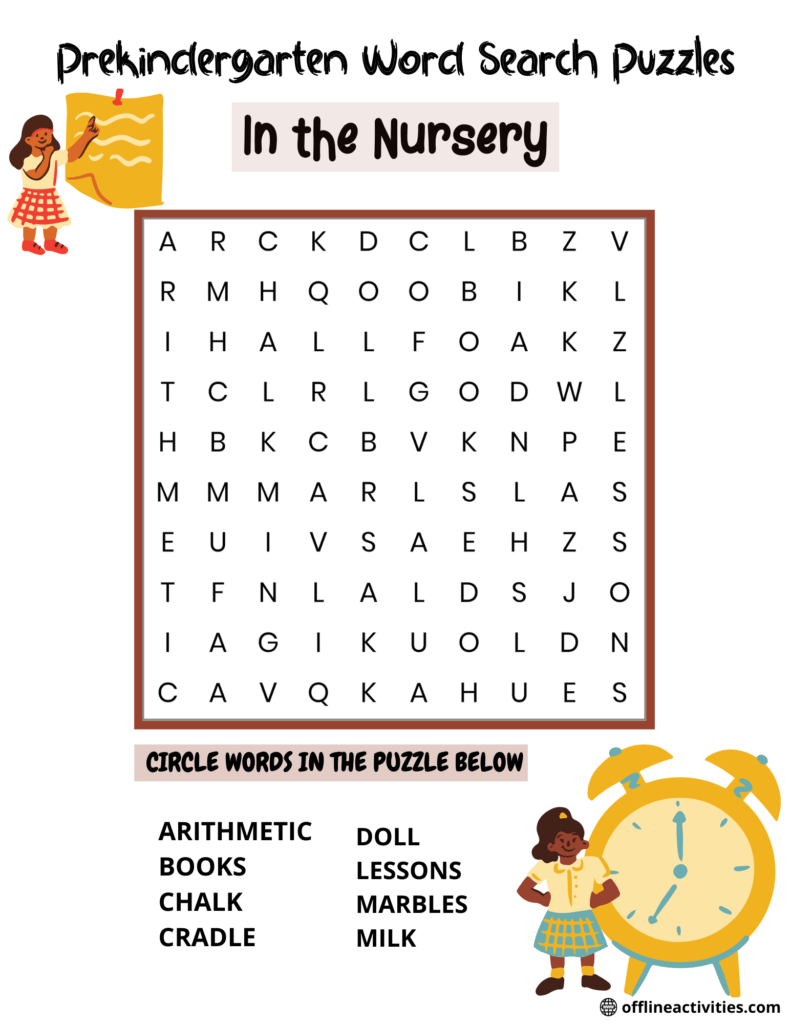
Sit together and look at the word list with wonder in your voice. “Look at this word—ARITHMETIC! That’s what they used to call math a long time ago. Can you imagine doing math with a chalkboard instead of a tablet?” Share small stories or ask questions about each word. “What do you think children played with MARBLES? How do you drink MILK from a bottle?”
Then, choose a word to find together. Model a patient, curious search: “Let’s look for CRADLE. It starts with C, just like ‘cat.’ I wonder if babies in olden times slept in cradles like this.” Your role is the gentle guide, weaving stories and encouragement together.
Adapting for Different Learners:
-
For Younger Prekindergarteners (Ages 3-4): Focus on just 3-4 of the most concrete words, like DOLL, MILK, and BOOKS. These are items they can easily visualize and connect to their own world.
-
For Older Prekindergarteners and Kindergarteners (Ages 5-6): Use the full puzzle. To deepen the experience, ask them to imagine what each item looked like long ago versus today.
-
For Children Fascinated by History: Bring in real objects if possible—a vintage doll, actual chalk, old-fashioned marbles. Let them touch and explore before starting the puzzle.
Creative Extension Ideas to Bring the Past to Life:
-
Then and Now Drawings: Fold a paper in half. On one side, have your child draw what CRADLE or BOOKS looked like long ago. On the other side, draw what they look like today. This builds comparison and observation skills.
-
Vintage Play Day: After completing the puzzle, have a day of old-fashioned play. Play with marbles, write with chalk on a sidewalk, drink milk from a special cup, and pretend to have “arithmetic” lessons.
-
Interview a Grandparent: If possible, have your child ask an older relative about these words. Did they play with marbles? Did they drink milk from bottles? What were their lessons like? This builds oral language and family connection.
The Educational Foundations of Thematic Learning
In my years of teaching, I’ve observed that children remember best what they feel deeply about. A word like “MARBLES” learned through a story about children playing long ago is far more likely to stick than the same word presented on a flashcard. This is the power of thematic, emotionally connected learning.
From a cognitive perspective, this activity engages multiple brain systems. The hippocampus links the new vocabulary to existing knowledge about the world. The visual cortex processes the letter shapes. The prefrontal cortex manages the focused attention needed for the search. This integrated processing creates stronger, more retrievable memories.
This approach aligns beautifully with project-based learning, where children explore a topic deeply through multiple lenses. It also reflects Montessori principles by using concrete, meaningful vocabulary and allowing for self-paced mastery. The nostalgic theme adds a layer of cultural literacy, connecting children to the broader human story. Parents and teachers can trust this as a safe, enriching activity that honors both cognitive development and the child’s natural curiosity about the world.
Learning Modality: Thematic Word Search vs. Generic Vocabulary App
Frequently Asked Questions
Isn’t “ARITHMETIC” too hard for a prekindergartener?
It’s a long word, but that’s part of the fun! Young children love big, important-sounding words. Treat it as a special challenge. Break it into chunks: “Let’s find ARITH together, then METIC!” The goal isn’t mastery but joyful exposure.
My child doesn’t know what some of these things are. Is that a problem?
This is actually the beauty of the puzzle! It opens the door for wonderful conversations. Take time to explain each item. Show pictures online or in books. Let this puzzle be the start of a mini-history lesson.
How can I use this in a preschool classroom?
It’s perfect for a “Long Ago and Today” theme unit. Use it as a center activity after reading books about pioneer children or the “olden days.” Pair it with artifacts or pictures for a rich, multi-sensory experience.
What if my child finishes the puzzle quickly?
Wonderful! That means they’re engaged. Move to the extension activities—drawing, interviewing grandparents, or having a vintage play day. The real learning happens in these connected experiences.
Can this help with intergenerational connections?
Absolutely! Share this puzzle with grandparents or older friends. Let your child “teach” them the words and ask about their own childhood memories. It’s a beautiful bridge between generations.
Do you have more history-themed printables?
We offer a growing collection of resources that explore different times and places, all designed to spark curiosity and build literacy through calm, screen-free activities.
Planting Seeds of Curiosity About the World
The words we give our children are more than tools for reading—they are windows into worlds. This vintage-inspired word search opens a small window into the past, inviting your little one to wonder about children who came before, who played with marbles and drank milk from bottles and learned their ARITHMETIC with chalk and slate.
We hope you’ll download this printable and travel back in time together. Let it spark conversations, inspire drawings, and maybe even lead to a game of marbles on the floor. It’s a simple, beautiful way to build vocabulary while nurturing the timeless human gift of curiosity.