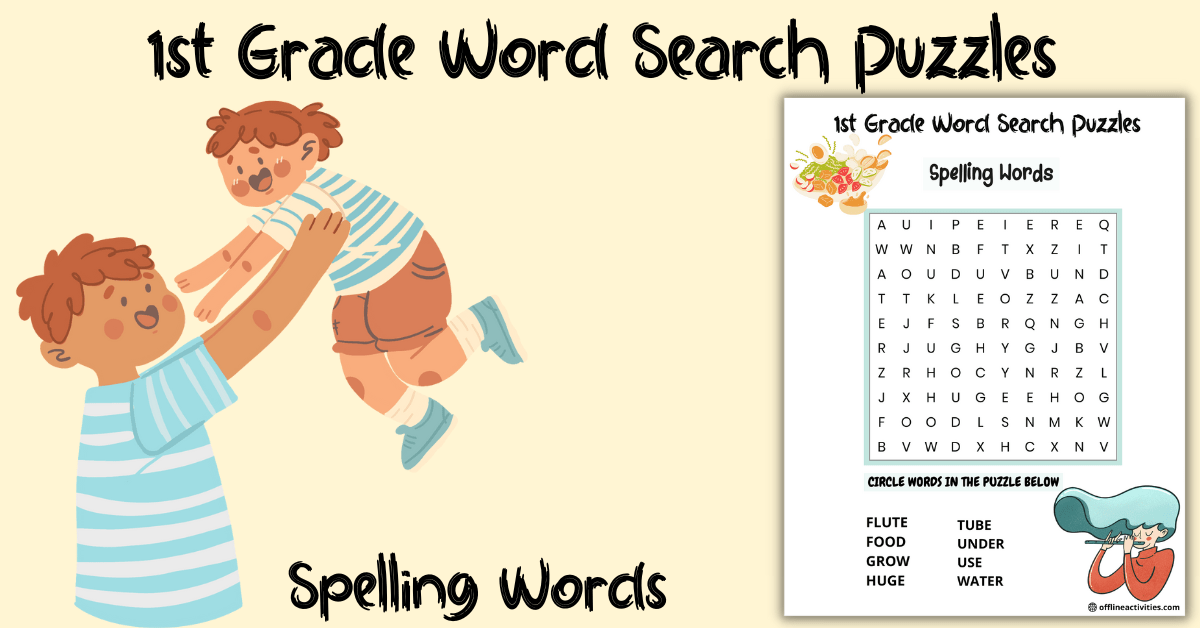
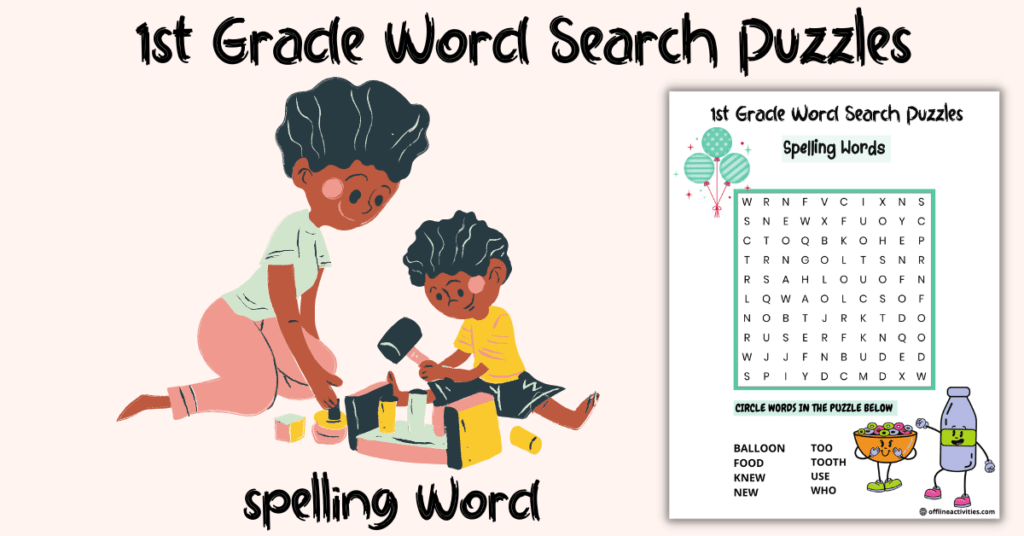
It often starts the same way at home or in the classroom. A child finishes their homework quickly, then asks, “What can I do now?” Screens are tempting, but many parents and teachers pause, wondering how to keep learning going without overstimulation. This is where simple, offline activities quietly shine. A Game of Word Search may look like a small puzzle, but it can turn an ordinary moment into focused learning time. This printable word search helps children practice spelling and word recognition while staying calm, engaged, and confident. In this article, you’ll discover how this activity supports early language skills and how to use it easily with children of different ages.

Print Puzzle
Why This Activity Works
Word search games offer children a gentle challenge that feels achievable. Instead of rushing through answers, children slow down, look carefully, and think.
This activity helps develop:
• Spelling awareness and word recognition
• Focus and sustained attention
• Problem-solving and logical thinking
• Fine-motor control through circling and marking
• Confidence through independent work
Because these games are played offline, children are free from digital distractions. Many educators observe that screen-free activities help children stay engaged longer and return to tasks more willingly. Printable puzzles often encourage deeper focus and stronger recall than fast-paced digital games.
How to Use the Activity at Home or in the Classroom
Download and Print
Begin by downloading the printable word search worksheet. Print one copy for each child. Black-and-white printing works perfectly, and additional copies can be printed for repeated practice.
Introduce the Words Gently
Before starting, read the spelling words together in a relaxed way. The words included in this puzzle are:
FLUTE
FOOD
GROW
HUGE
TUBE
UNDER
USE
WATER
You might say, “Let’s look at these words before we search for them.” Ask simple questions like, “Which word sounds the longest?” or “Do you see a word you already know?”
Guide Without Pressure
Encourage children to search slowly and carefully. Let them circle or mark each word as they find it. There’s no need to hurry—this activity is about focus, not speed.
Adjust by Age and Ability
For ages 5–6, search together and name letters aloud.
For ages 6–7, allow independent searching with gentle reminders.
For ages 7–8, add a follow-up task such as writing a sentence with each word.
Extend the Learning
You can deepen the experience by:
• Sorting words by length
• Finding words related to real objects (flute, food, water)
• Drawing a picture for one word
• Creating a short story using two or three words
Educational Foundations You Can Trust
Experience
In both home and classroom settings, word search games are often chosen during quiet learning moments because children feel relaxed and capable while completing them.
Expertise
This activity supports orthographic mapping, helping children connect written words with meaning. It also strengthens working memory, visual scanning, and early spelling accuracy.
Authority
The design aligns with Montessori-inspired independent work, active learning strategies, and kinesthetic learning through hands-on engagement.
Trustworthiness
This printable is safe, age-appropriate, and completely screen-free. It includes no ads within the worksheet and offers clear, simple instructions for parents and teachers.
Printable Word Search vs Screen-Based Learning
Printable Word Search
Encourages calm focus
Builds spelling and reading skills
Supports fine-motor development
Screen-free and low stress
Suitable for home and classroom use
Screen-Based Games
Short attention spans
Often overstimulating
Limited handwriting practice
Less consistent learning transfer
Frequently Asked Questions
What age is this activity best for?
This printable works well for children aged 5–8, including early readers and first-grade learners.
Can teachers use this in the classroom?
Yes. It is suitable for literacy centers, small-group activities, and independent work.
Is this helpful for ESL learners?
Yes. Visual repetition and structured word searching support early English language development.
How long does the activity take?
Most children complete the puzzle in 10 to 15 minutes.
How can I make it more engaging?
You can add colors, movement-based extensions, or follow up with drawing or storytelling.
Can this activity be reused?
Yes. Laminating the worksheet or using a plastic sleeve allows for repeated use.
Conclusion
Learning does not always need to be loud or fast-paced. Sometimes, the most meaningful progress happens in quiet moments with simple tools. A Game of Word Search offers children the chance to practice spelling, strengthen focus, and build confidence without screens or pressure.
Each word found is a small success—and those small successes add up to strong learning habits.
Download this printable and start a calm, screen-free learning moment today.
MORE PUZZLES FOR YOU:
Game Word Search Online- Spelling Words
Word Search Download- Spelling Words
Printable Word Search Puzzles- spelling Word