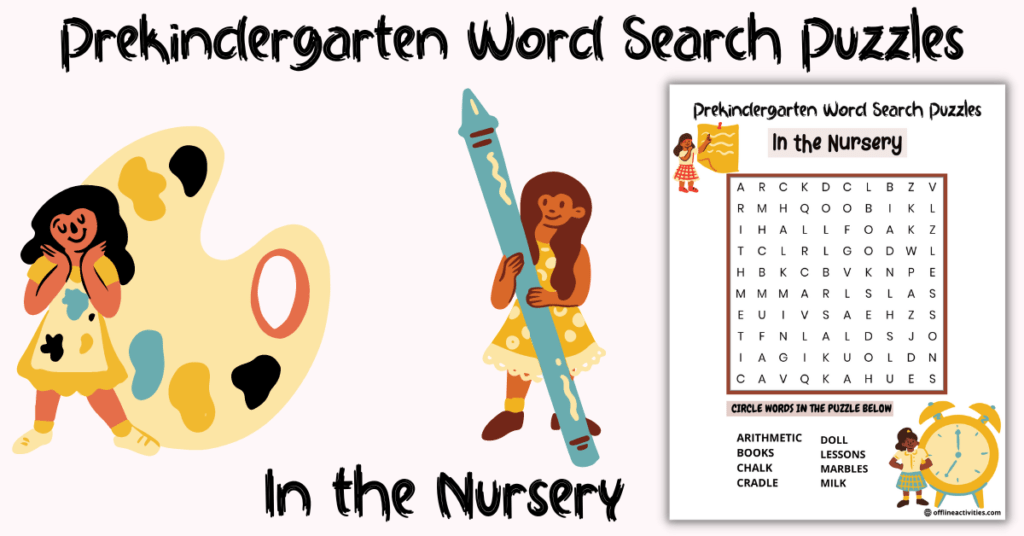
How to Use This Nursery Word Search with Your Child
This puzzle can become a special bonding activity, especially if you’re welcoming a new baby. Here’s how to introduce it with warmth and intention.
Simple Preparation:
Download the clear, inviting PDF. Print it on sturdy paper. For repeated use—perhaps while the baby naps—slip it into a plastic sheet protector. Let your child use colorful dry-erase markers or chunky crayons to circle the words. This makes the activity feel special and reusable.
Guiding the Experience with Connection:
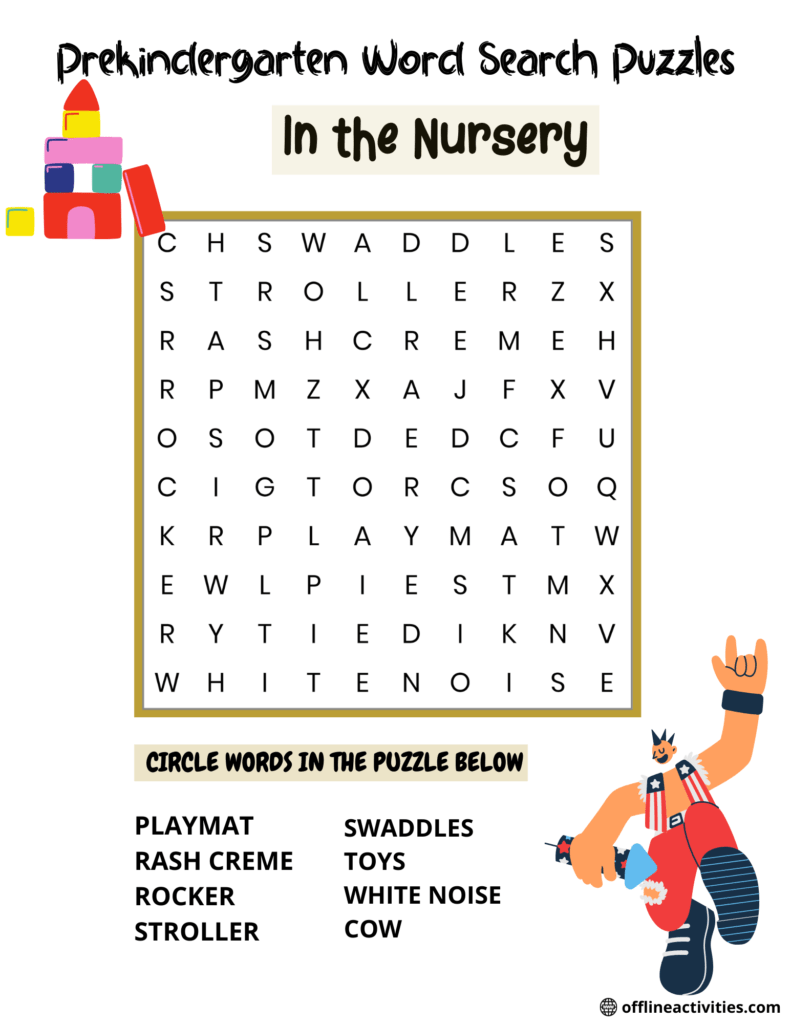
Sit together in a cozy spot, perhaps near the nursery or the play area. Look at the word list and connect each word to something real. “Oh, look! STROLLER—that’s where we go for walks!” or “TOYS—those are your special things you share with the baby.” This conversation builds both vocabulary and emotional connection.
Then, choose a word to find together. Model a gentle search: “Let’s look for ROCKER. It starts with R, just like your name starts with …” Use a warm, encouraging tone. Celebrate each find with genuine delight. Remember, this isn’t a test; it’s a shared discovery.
Adapting for Your Child’s Age and Stage:
-
For Younger Preschoolers (Ages 3-4): Focus on just 3-4 of the most familiar words, like TOYS, COW, and PLAYMAT. You can even help by placing a small sticker next to the first letter of each target word as a friendly clue.
-
For Kindergarteners and Confident Learners (Ages 5-6): Use the full puzzle. To add a writing connection, have them draw a small picture of each word after they find it.
-
For Children Who May Feel Left Out: Let them be the “baby expert.” Ask them to explain each word to you as you find it. “What does WHITE NOISE sound like? Can you show me?” This empowers them and validates their important role.
Fun Extension Ideas to Deepen the Play:
-
Nursery Scavenger Hunt: After finding the words on paper, go on a real-life scavenger hunt around the house. Can you find the actual ROCKER? Where is the RASH CREME kept? This bridges the puzzle to the physical world.
-
Big Helper Cards: Write each word on an index card. Let your child “read” the card and then fetch that item when the baby needs it. “Can you bring the SWADDLES?” This builds reading confidence and a sense of purpose.
-
Draw and Tell: Have your child draw a picture of the nursery including as many of the words as they can. Talk about the drawing together, using the new vocabulary naturally.
The Educational Foundations of Real-World Learning
In my years of working with young children, I’ve observed that the most powerful learning moments happen when we connect abstract skills to a child’s tangible world. A word like “STROLLER” means something deeply personal to a child with a new sibling. It carries emotion, memory, and identity. When we honor that by placing it in a learning activity, we send a powerful message: your life matters, and the words in it are worth knowing.
From a cognitive development perspective, this puzzle builds semantic memory—the part of long-term memory that processes ideas and concepts. By linking the written word “SWADDLES” to the actual experience of watching a baby being wrapped, the child creates a rich mental file that is much easier to retrieve later.
This approach is grounded in experiential learning theory, which emphasizes that we learn best through direct experience and reflection. It aligns with Montessori principles by using real-world, meaningful vocabulary as the foundation for language work. It also honors the child’s emotional world, making it not just educationally sound but developmentally nurturing. Parents can trust this activity as a safe, gentle, and profoundly effective way to support both literacy and family connection.
Learning Through Connection: Printable Puzzle vs. Baby-Themed App
Frequently Asked Questions
My child is only three. Is this too hard?
Not at all! At this age, the goal isn’t independent completion. Sit together, point to the first letter of TOYS or COW, and let them try to find a match. The value is in the connection and the introduction to the idea that words have meaning.
We don’t have a new baby. Can we still use this?
Absolutely! These are wonderful nursery words that any child finds fascinating. You can talk about when they were a baby, or use it before visiting a friend with a newborn. It’s a lovely way to explore this universal stage of life.
How can this help my older child adjust to a new sibling?
Giving a child language for their new world is empowering. This puzzle validates their experience and gives them a way to participate. As you find words together, you naturally create space for conversation about how they’re feeling.
Can this be used in a preschool classroom?
Yes! It’s perfect for a “babies” or “families” theme. It sparks wonderful discussions about siblings, when students were little, and how families grow. It’s also a gentle way to support children who may have a new baby at home.
What if my child doesn’t know what “WHITE NOISE” or “RASH CREME” is?
This is a wonderful opportunity for conversation! Explain what these items are and why we use them for babies. You might even show them the real object. Building vocabulary is about more than words—it’s about understanding the world.
Do you have more printables about family or everyday life?
We offer a growing collection of resources that connect literacy to a child’s real world, including family-themed word searches, “all about me” activities, and printables that celebrate everyday routines and relationships.
Building Vocabulary and Connection, One Word at a Time
The words that fill a child’s world are the building blocks of their understanding. By honoring those words—by placing them on a page and inviting a child to find them—we tell them that their life matters. This simple nursery word search does more than build literacy; it builds connection, confidence, and a sense of belonging during a time of change.
We invite you to download this printable and share it during a quiet moment with your little one. Whether you’re welcoming a new baby or simply exploring the world of the nursery together, this gentle activity offers a screen-free way to connect, learn, and celebrate the words that make up your family’s story.