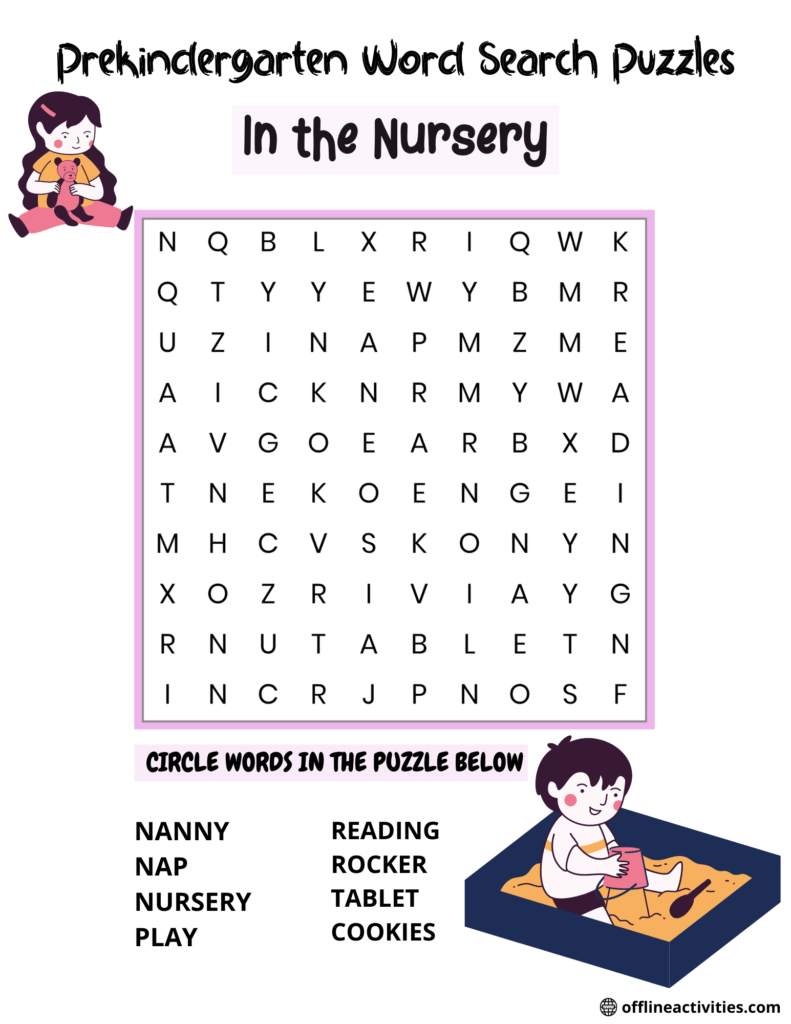
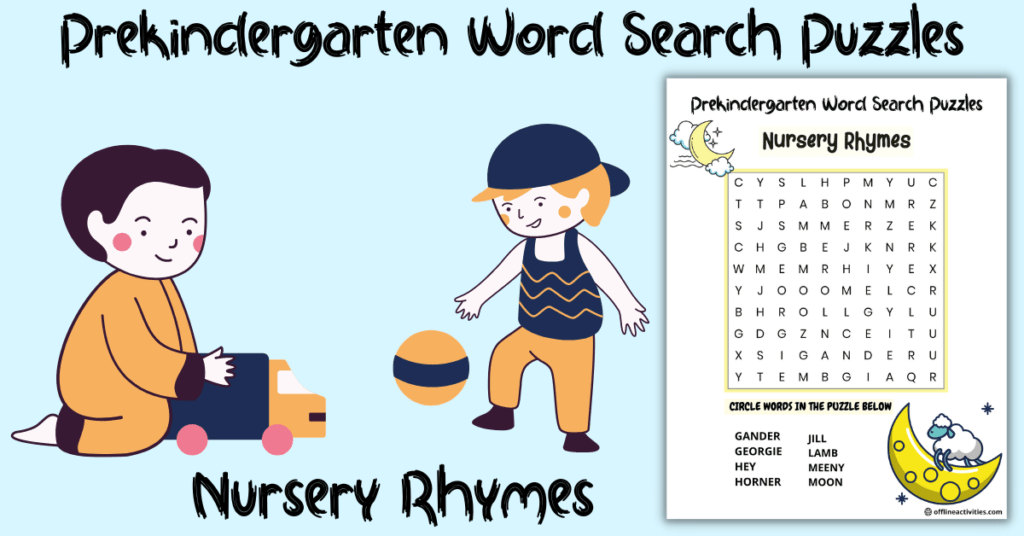
These words are familiar and relatable, making the puzzle both approachable and enjoyable for young learners.
How to Use the Activity
Using this printable activity at home or in a classroom setting is simple and flexible. The goal is to create a relaxed learning moment rather than a timed challenge.
Start by downloading the worksheet from the activity page and printing it on standard letter-size paper. Printing in full size helps ensure the letters are easy for children to see and trace.
Before beginning the puzzle, read the vocabulary words together with the child. Saying the words aloud helps them recognize the sounds and connect them with the printed letters. You can also ask simple questions like, “Which of these words do you recognize?” or “Have you seen a rocker before?”
Next, invite the child to begin exploring the puzzle grid. Explain that the words may appear horizontally, vertically, or diagonally. Encourage the child to search slowly and carefully.
If the child finds a word, they can circle it with a pencil or highlight it with a colored marker. Many children enjoy using different colors for each word they discover.
You can easily adapt the activity depending on the child’s age and experience.
For children aged 3–4, work together to locate one or two words. This keeps the experience positive and prevents frustration.
For children aged 5–6, encourage independent searching while offering gentle hints when needed.
For children aged 7–8, turn the puzzle into a small challenge by asking them to locate all the words and then read them aloud.
You can also extend the activity in creative ways. For example, ask the child to draw a picture of one of the vocabulary words they found. Another idea is to create a short story using several of the puzzle words. These small extensions help reinforce vocabulary while encouraging imagination.
Educational Foundations (E-E-A-T)
Activities like word searches are widely used in early childhood education because they support multiple learning approaches in a simple and engaging format.
From an experience perspective, teachers often include puzzles like this in classroom literacy centers. Children enjoy the challenge of searching for hidden words, and the activity naturally encourages quiet concentration.
From an expertise standpoint, word searches strengthen visual discrimination and letter recognition. As children scan the grid, they practice identifying letter patterns and sequences, which supports early reading development.
This type of activity also reflects Montessori-inspired learning principles. Montessori classrooms emphasize hands-on discovery and independent exploration. Word search puzzles allow children to interact with written language at their own pace while developing confidence.
The puzzle also supports kinesthetic learning. Even though it is a quiet activity, children are physically engaged through scanning, circling, and tracing letters. This combination of visual and physical interaction helps reinforce memory and comprehension.
Finally, the activity is trustworthy for parents and teachers because it is age-appropriate, safe, and screen-free. It encourages learning through exploration rather than pressure.
Printable Word Search vs Screen-Based Word Games
Learning Factor | Printable Word Search Puzzle | Screen-Based Word Game
Focus and attention | Encourages steady concentration | Often interrupted by sounds and animations
Physical interaction | Children circle and highlight letters | Limited physical engagement
Screen exposure | Completely screen-free | Requires device use
Learning pace | Calm and self-guided | Often fast-paced
Classroom suitability | Easy to print and distribute | Requires technology access
This comparison shows why many educators continue to rely on printable activities as part of balanced learning routines.
Frequently Asked Questions
What age group is this activity designed for?
This word search puzzle is suitable for children aged 3 to 8. Younger learners can complete it with guidance, while older children can search independently.
Can teachers use this activity in the classroom?
Yes. Teachers often use printable puzzles during literacy centers, quiet work periods, or as early-finisher activities for students who complete other tasks quickly.
Is this activity suitable for children learning English as a second language?
Yes. Because the vocabulary relates to familiar nursery experiences, children can easily connect spoken words with their written forms. This supports language learning in a natural way.
How long does the activity usually take?
Most children complete the puzzle in about 5 to 10 minutes. Younger children may take longer if they are working with an adult.
How can I make the puzzle more engaging?
You can turn the activity into a small game by using colored pencils, setting a gentle time challenge, or asking children to draw pictures related to the words they find.
Can siblings or classmates work together on the puzzle?
Yes. Collaborative puzzles encourage teamwork and conversation. Children often enjoy helping each other locate hidden words.
Conclusion
A nursery-themed word search puzzle offers a simple and meaningful way to support early literacy development. As children search for familiar words hidden in the grid, they strengthen vocabulary, improve concentration, and practice recognizing letter patterns.
Printable activities like this also provide something many families and classrooms value: a calm learning moment without screens. With just a printed page and a pencil, children can explore language in a playful and supportive environment.
Download this printable worksheet and start a quiet, screen-free learning moment with your child today.