
As I was cleaning out our learning cupboard recently, I found a stack of completed puzzles and homemade storybooks from years past. It struck me how each one represented not just a finished task, but a specific, quiet moment of deep engagement. In today’s world, creating those focused moments for our 7-year-olds requires a bit more intention. The pull of screens is strong, and while they have their place, the need for activities that build tangible skills and foster real-world curiosity has never been greater. This reflection isn’t about eliminating technology, but about consciously choosing to supplement it with rich, screen-free activities for 7-year-olds that nurture the whole child—their growing mind, their creative spirit, and their need for tactile, social play. Let’s explore how purposeful offline time can become the cornerstone of balanced, joyful development.
Why Intentional Screen-Free Time Works
At age seven, children are at a powerful crossroads of development. Their brains are primed for complex problem-solving, social negotiation, and creative expression. Screen-free activities are uniquely positioned to harness this potential because they demand active participation rather than passive consumption. When a child builds a fort, they are engaging in spatial reasoning, physics, and project-based planning. When they work on a puzzle with a friend, they are practicing patience, communication, and collaborative problem-solving.
These activities directly counter the often fragmented attention cultivated by rapid-screen switching. Offline play strengthens sustained focus, allowing a child to immerse themselves in a task from start to finish. This builds neural pathways for patience and perseverance. Furthermore, hands-on activities are crucial for sensory integration and fine motor development—skills that are under-stimulated by swiping and tapping. The cognitive benefits are clear: children engaged in frequent, complex play demonstrate stronger executive function, including better working memory and cognitive flexibility, which are fundamental to academic and life success.
How to Curate a Screen-Free Environment
Moving from intention to action doesn’t require a complete overhaul of your home. It’s about thoughtful curation and invitation.
Start with Access and Presentation:
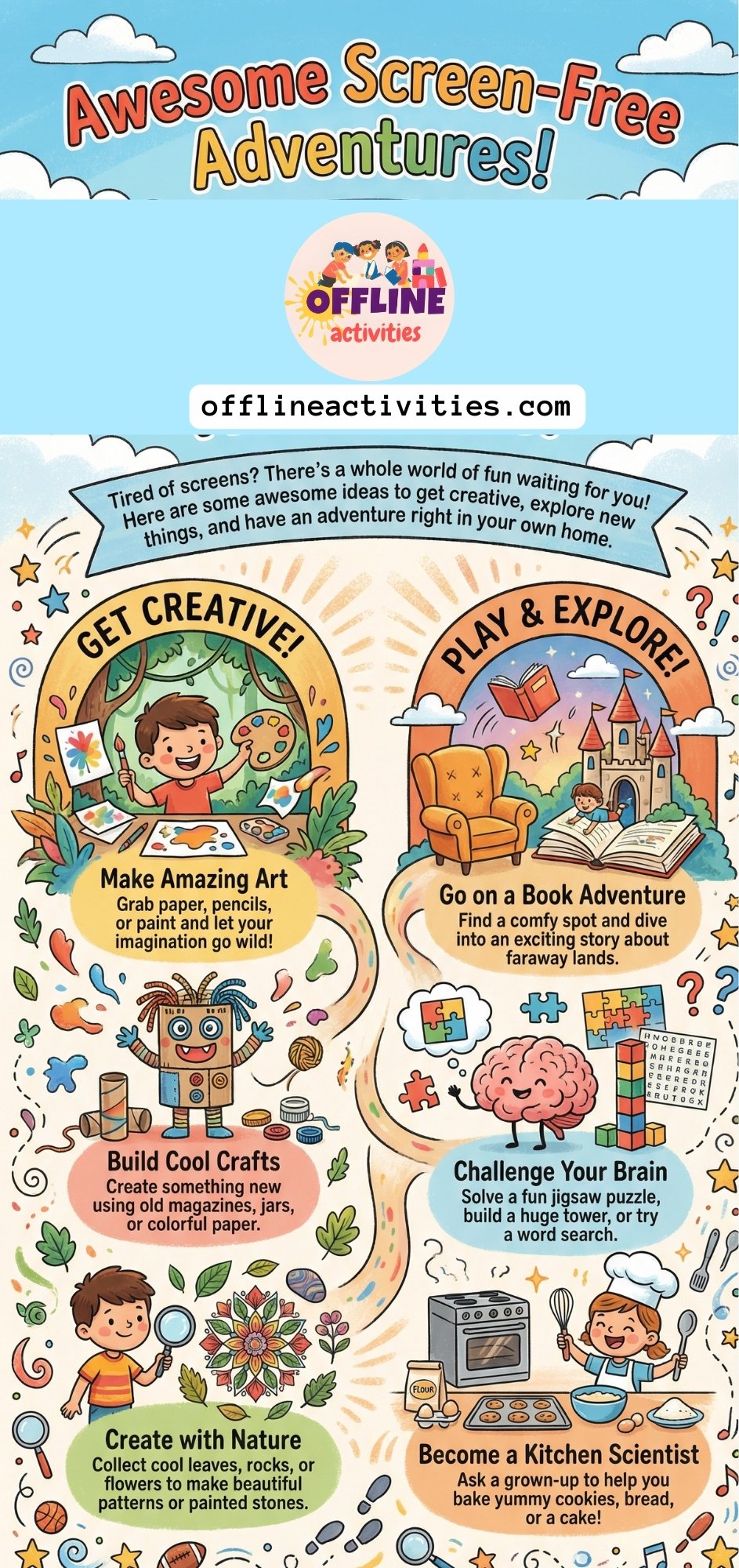
Instead of hiding crafts in a closet, create an “Invitation to Create” station. Use open baskets or clear bins to display attractive, accessible materials: colored paper, washable markers, modeling clay, building blocks, and interesting natural items like smooth stones or pinecones. For printable activities like our word searches or puzzle packs, keep them in a dedicated binder or magazine holder. The key is to make the offline options as visible and appealing as the tablet.
Guiding with Presence, Not Pressure:
Your role shifts from scheduler to facilitator. Begin by modeling engaged play yourself. Sit down and start drawing, or begin building with blocks. Often, a child will naturally gravitate and join. For structured activities, introduce them with curiosity: “I found this neat word search about the garden. Want to be word detectives with me?” Use open-ended questions during play: “What do you think will happen if we add more weight to this side of the balance?” This supports their critical thinking without directing the outcome.
Adapting Activities for Interest and Skill:
-
For the Active Child: Channel energy into purposeful projects. Building a blanket fort engineering challenge, creating an obstacle course with specific rules, or starting a backyard garden engages their body and mind.
-
For the Quiet Thinker: Offer deep-dive activities like detailed jigsaw puzzles, beginner’s coding board games (like Robot Turtles), or science experiment kits with clear, multi-step instructions.
-
For the Social Butterfly: Prioritize games and projects built for collaboration. Think cooperative board games (where players work together against the game), putting on a play, or organizing a neighborhood scavenger hunt.
Weaving Activities into the Rhythm of Your Week:
Think in themes to provide variety and depth. You might have a “Maker Monday” for crafts, a “Wild Wednesday” for nature exploration, and a “Game Night Friday” for family puzzles and board games. This creates predictable anticipation, not boredom. Rotate the materials in your activity stations every week or two to renew interest and present fresh challenges.
The Educational Foundations of Purposeful Play
In my work designing learning experiences, I always return to the principle that play is the work of childhood. The activities we choose are the “materials” for that work. A simple crafting session is an exercise in divergent thinking—there is no single right answer, which fosters incredible creativity and risk-taking. A board game is a lesson in systems thinking, rule-following, and graciousness in both winning and losing.
This philosophy is deeply connected to Reggio Emilia and Montessori approaches, which view the environment as the “third teacher” and emphasize self-directed, experiential learning. When we provide open-ended materials and meaningful challenges, we honor the child’s innate curiosity and capability. We build trustworthiness by offering activities that are safe, age-appropriate, and respect the child’s pace and interests, creating a foundation of security from which they can explore confidently.
Two Paths of Engagement: A Reflective Comparison
| Aspect of Learning | Curated Screen-Free Activity Time | Unstructured Digital Entertainment |
|---|---|---|
| Cognitive Demand | Requires initiation, planning, and self-sustained focus. The child drives the engagement. | Often reactive; the app or game provides constant stimuli and rewards, demanding less internal motivation. |
| Skill Transfer | Develops broad, real-world skills (fine motor, spatial reasoning, social negotiation) applicable across life domains. | Skills (like quick tapping or navigating menus) are often specific to the digital interface. |
| Error and Resilience | Natural mistakes (a tower falls, a puzzle piece doesn’t fit) are inherent and teach iterative problem-solving and resilience. | Mistakes often lead to a simple “Game Over” reset, offering a less nuanced lesson in persistence. |
| Social Connection | Often fosters face-to-face interaction, shared laughter, and the need to communicate and compromise. | Can be isolating; even multiplayer games lack the non-verbal cues and shared physical space of real interaction. |
| Legacy of Play | Creates physical artifacts (art, builds, journals) and lived memories that a child can reflect on with pride. | Creates digital data points and achievements that are less tangible and rarely revisited. |
Frequently Asked Questions
I’m not a “crafty” or “outdoorsy” parent. Can I still do this?
Absolutely! Being a facilitator isn’t about being an expert. It’s about providing resources and sharing curiosity. You can learn alongside your child. Many STEM and building activities require no prior skill—just a willingness to try and see what happens.
How much screen-free time should we aim for?
Think in terms of balance, not absolutes. A helpful goal is to ensure that for every hour of recreational screen time, there is an equal or greater opportunity for unstructured or creatively structured offline play. Focus on the quality of the alternative activities offered.
My child complains of boredom the second screens are off. What now?
“Boredom” is often the uncomfortable gateway to self-motivation. Instead of immediately providing a solution, respond with, “That’s interesting. What does your brain feel like doing? Building, creating, moving, or exploring?” Then, guide them to the appropriate activity station. The goal is to help them build the muscle of self-directed play.
Are some screens better than others?
Yes, but with caution. An educational app or a video call with a grandparent serves a different purpose than passive YouTube viewing. The key is intentionality: Why is the screen on right now? If the purpose is clear and time-limited, it can be part of a healthy balance. The problem arises when screens become the default, filling all gaps.
How do I handle pushback from my child or other parents?
Stay calm and centered in your “why.” You can explain simply: “In our family, we really value time for building, imagining, and playing face-to-face.” For other parents, you need not defend; simply share what works for you. Often, sharing a fun, successful screen-free activity idea is more persuasive than a debate.
Where do printable activities like word searches fit in?
Perfectly! They are a fantastic “bridge” activity. They provide just enough structure to focus a busy mind, while still being tactile and offline. They’re excellent for quiet time, travel, or as a warm-up to more open-ended play.
The Lasting Imprint of Real-World Experience
Choosing screen-free activities is, at its heart, a choice to preserve space for childhood as it has always been best lived: through messy hands, wondering eyes, and shared laughter. It’s an investment in a child’s ability to concentrate, to create something from nothing, to navigate a disagreement with a friend, and to find wonder in the clouds or in the gears of a simple machine. These are the experiences that build not just skills, but character.
This journey isn’t about perfection. It’s about making small, intentional choices to swap a passive moment for an engaged one. We invite you to download our curated collection of printable activities as a first step. Let it be a tool to help you create more of those quiet, focused moments that you—and your child—will look back on with fondness.
YOU MAY ALSO LIKE
How Printable Games Help Kids Learn Without Screens
Screen Free Activities For 2 Year Olds
How to Motivate Kids to Learn Offline?
The Role Of Crafts In Developing Motor Skills And Focus