
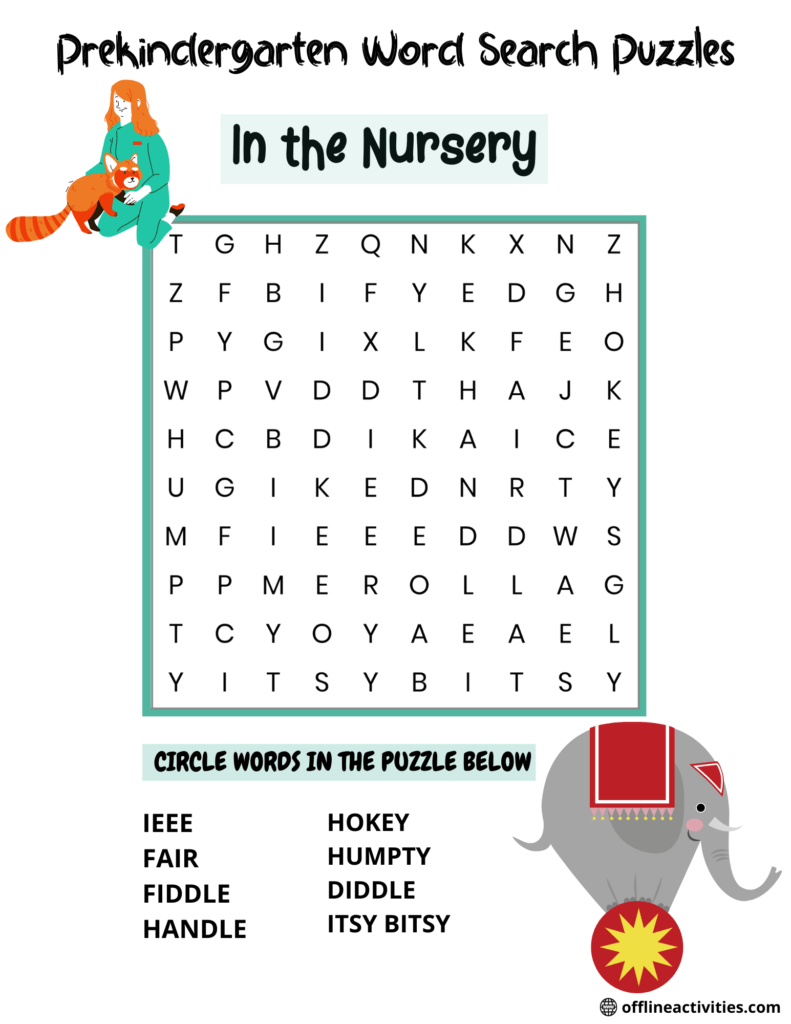
The other afternoon, I watched my three-year-old niece hum “Itsy Bitsy Spider” while tracing her finger across a page. She wasn’t reading yet, but she was searching for the letters that spelled the words she loved to sing. That moment reminded me how powerful familiar, playful language can be for our youngest learners. For parents of preschoolers, finding activities that feel like play yet build real skills is a beautiful challenge. This preschool nursery rhymes word search, featuring words like HUMPTY, FIDDLE, and ITSY BITSY, offers that perfect blend. It invites little ones to explore letters through the lens of beloved songs and stories, turning early literacy into a gentle, joyful discovery.
Why This Nursery-Themed Activity Works So Well
For prekindergarten children, learning happens best when it’s wrapped in what they already love. Nursery rhymes are the oral tradition of childhood—they carry rhythm, repetition, and comfort. By placing words from these familiar rhymes into a simple word search, we create a bridge between spoken language and written text.
This activity nurtures several foundational skills. First, it builds phonological awareness—the ability to hear and play with the sounds in words. When a child searches for “HANDLE” or “DIDDLE,” they are connecting the sounds they know from singing to the letters on the page. This connection is the bedrock of reading.
The puzzle also develops visual discrimination, the skill of noticing differences between similar letters. A young eye learning to distinguish between ‘b’ and ‘d’ gets gentle practice in a low-pressure setting. The fine motor act of circling each found word supports pencil control and hand strength. As a completely screen-free activity, it honors the young child’s need for calm, focused time away from flashing screens. Early childhood research consistently shows that hands-on, playful interactions with print materials build stronger neural pathways for reading than passive screen exposure.
Print Puzzle
How to Introduce This Puzzle to Your Little One
Working with a prekindergartener requires patience, warmth, and a willingness to follow their lead. Here’s how to make this activity a positive experience.
Simple Preparation:
Download the cheerful PDF and print it on sturdy paper. For little hands, consider printing it slightly larger if your printer allows. A plastic sheet protector and a chunky, washable dry-erase marker make this a reusable favorite. The ease of wiping clean invites endless repetition, which young children naturally crave.
Guiding the Experience with Gentleness:
Begin by sitting close together and looking at the word list. Sing a line from “Humpty Dumpty” or “The Itsy Bitsy Spider” together. Connect the words to the songs they know. Then, point to a word like “FAIR” and say, “Let’s go on a letter hunt for our friend FAIR. Can you find the big F?”
Your role is that of a patient partner, not a teacher. If they lose interest after one word, that’s perfectly fine. Celebrate that one find with genuine delight. Use encouraging, specific praise: “You found the ‘F’ all by yourself! Your eyes are working so hard.”
Adapting for Your Child’s Stage:
-
For Young Threes or Newcomers to Letters: Focus only on the shortest, most distinctive words like “FAIR” or “SEE.” Forget circling for now—just help them spot the first letter of the word. Success might look like pointing to an ‘F’ and saying, “There it is!”
-
For Fours and Fives Ready for More: Introduce the full puzzle. Work together, taking turns finding words. You find one, then they find one. This builds confidence and turns it into a cooperative game.
-
For Extra Engagement: Let them use colorful dot markers instead of circling. Dabbing a dot on each found letter is hugely satisfying for little hands.
Creative Extensions to Keep the Magic Alive:
-
Act It Out: When you find “HUMPTY,” stand up and pretend to be a wall, then wobble and fall down gently. This kinesthetic connection cements the word’s meaning.
-
Sing and Search: As you find each word, sing the part of the rhyme where it appears. “HUMPTY Dumpty sat on a WALL…” (though WALL isn’t in this puzzle, you can add it!)
-
Create a Rhyme Basket: Collect small toys or objects that connect to the words—a tiny spider for ITSY BITSY, a small horse for FIDDLE (as in “Hey diddle diddle”). Let your child hold them while you work on the puzzle.
The Educational Foundations of Rhyme-Based Learning
In my years of working with young children, I’ve seen how nursery rhymes serve as a child’s first introduction to story structure, rhythm, and language play. They are the original literacy tool, passed down through generations. Incorporating them into a simple puzzle honors that tradition while meeting modern educational needs.
From a cognitive perspective, this activity engages multiple brain systems simultaneously. The auditory cortex recalls the familiar melody of the rhyme. The visual cortex processes the letter shapes. The motor cortex guides the hand to circle the word. This multi-sensory integration is precisely how young brains build strong learning connections.
This approach is deeply rooted in developmentally appropriate practice, which emphasizes learning through play and meaningful context. It aligns with Montessori principles by offering a concrete, self-correcting material that respects the child’s pace. It also embodies kinesthetic learning by connecting physical action to cognitive work. Parents and teachers can trust this as a safe, gentle, and profoundly effective way to nurture early literacy without pressure or screens.
Early Literacy Tool: Word Search vs. Digital Letter App
| Learning Dimension | Nursery Rhyme Word Search | Digital Letter Tracing App |
|---|---|---|
| Sensory Engagement | Tactile paper experience with real markers, engaging multiple senses. | Limited to glass-smooth screen with uniform haptic feedback. |
| Pacing & Pressure | Child-led and self-paced. No timers, no “wrong” sounds, no. | Often includes timers, sounds for correct/incorrect, and programmed pacing. |
| Connection to Oral Language | Easily paired with singing, conversation, and real-world connection. | Isolated from the rich oral language environment of family interaction. |
| Attention Span | Encourages sustained focus on a single, calm activity. | Often designed with quick scene changes and rewards that fragment attention. |
| Tangible Achievement | Creates a physical paper to display, revisit, and feel proud of. | Achievement is digital and intangible—easily forgotten. |
Frequently Asked Questions
My child is only three. Isn’t this too advanced?
Not at all! For a young three, the goal isn’t to complete the puzzle. It’s to explore letters in a loving context. Point to the big H in HUMPTY. Let them scribble near it. The positive association with print is the real achievement at this age.
What if my child doesn’t know these nursery rhymes yet?
This is a wonderful opportunity to introduce them! Before starting the puzzle, spend a few days singing “Humpty Dumpty,” “Hey Diddle Diddle,” and “The Itsy Bitsy Spider.” The puzzle becomes a celebration of songs they now love.
Can this help a child who is speech delayed?
Nursery rhymes are actually recommended by speech therapists! The rhythm and repetition support language development. Using this puzzle alongside singing can provide a multi-sensory boost. Always consult with your speech professional for personalized advice.
How can I use this in a preschool classroom?
It’s perfect for small group literacy centers. Have a “nursery rhyme week” and use this puzzle as one station. Sing the rhyme together first, then invite children to find the words with a partner. It builds community alongside skills.
My child wants to do the same puzzle every day. Is that okay?
Absolutely! Repetition is how young children master concepts. Each time, they will notice something new. Using a dry-erase sleeve makes this daily ritual easy and sustainable.
Do you have more nursery rhyme activities?
We offer a growing collection of printable resources inspired by classic rhymes, including sequencing cards, coloring pages, and movement activities—all designed for calm, screen-free learning.
Planting the Seeds of a Lifelong Love for Words
The journey into reading begins not with flashcards or apps, but with lap time, songs, and the gentle discovery that marks on a page can hold the stories we love. This nursery rhyme word search is a small invitation into that world. It says to a child: the words you sing, the rhymes you love—they live here too, waiting for you to find them.
We hope you’ll Download this Printable and share it in a quiet, cozy moment. Sing a little, search a little, and watch your child’s eyes light up with the magic of their own discovery. It’s a simple, beautiful way to begin.
MORE PUZZLES FOR YOU:
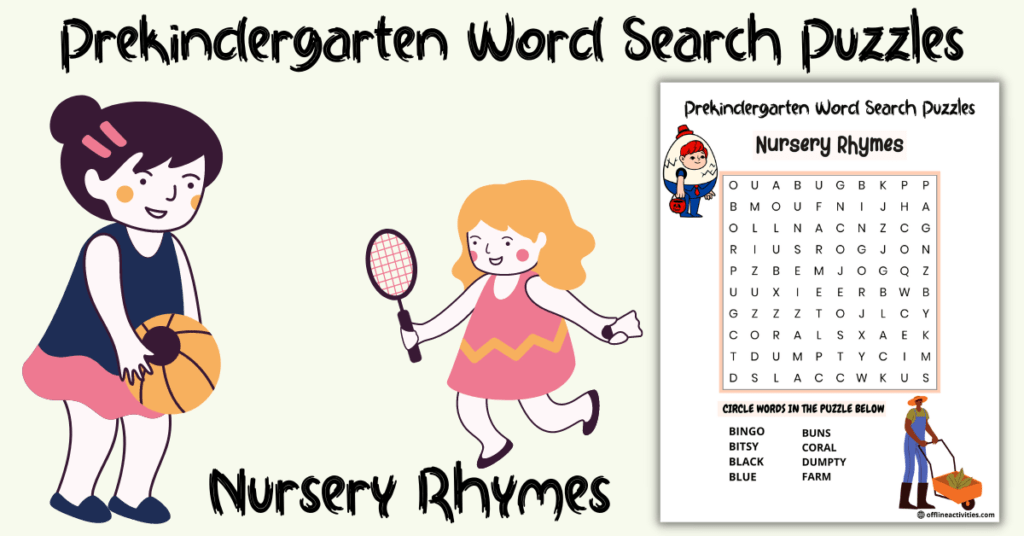
Word Search Puzzles pdf- Nursery Rhymes
Word Search for Prekindergarten
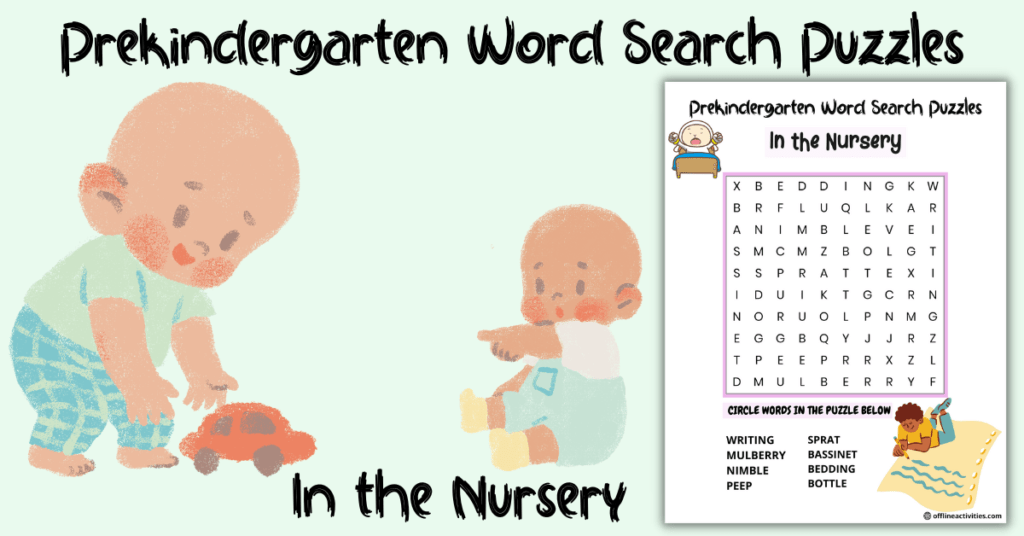
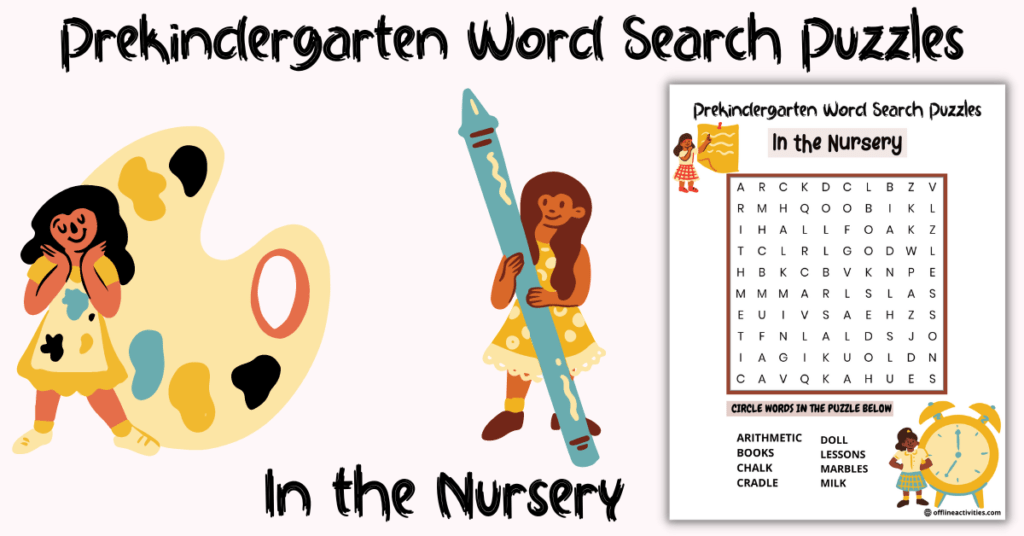
Prekindergarten Word Search Puzzles- In the Nursery