How to Guide Your Child Through This Learning Activity
Using this printable effectively is about setting the stage for success and then stepping back to let your child’s natural curiosity lead.
Preparation is Simple:
Start by downloading the clean, easy-to-read PDF file. Print it on standard paper. For a reusable classroom or home resource, I highly recommend placing the sheet in a dry-erase pocket. Children love using colored dry-erase markers, and it allows for endless practice without wasting paper.
Facilitating a Positive Experience:
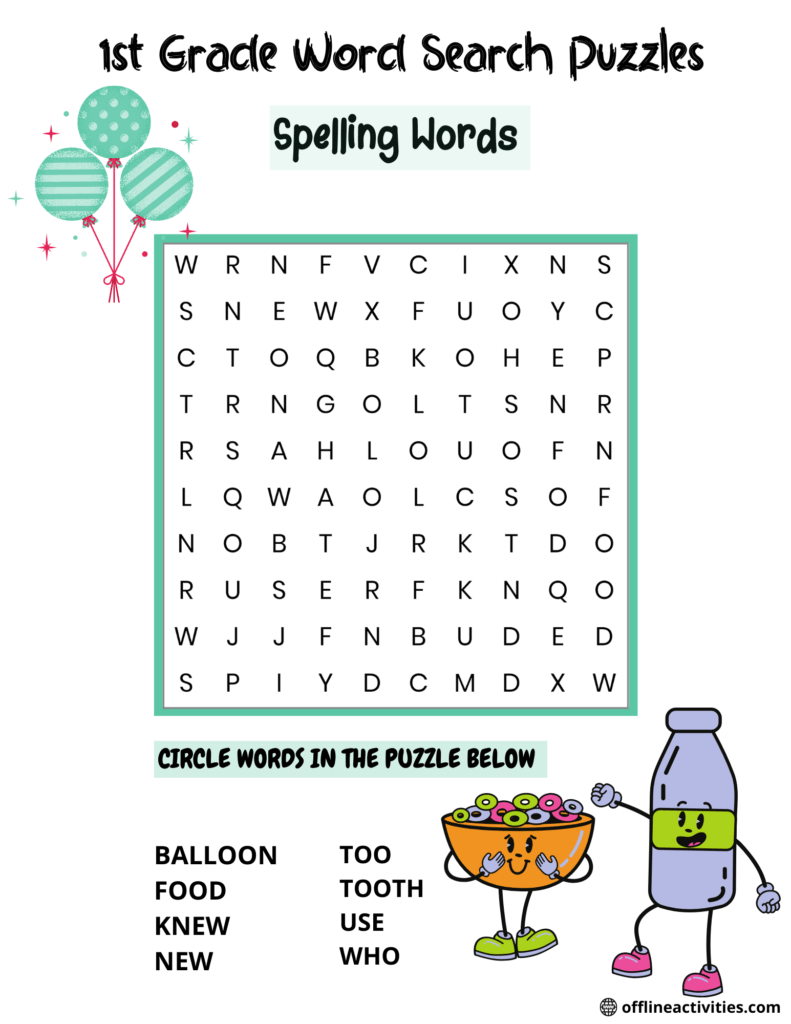
Begin by reading the list of sight words together. Pay special attention to homophones like “NEW/KNEW” and “TOO/TOOTH.” Discuss their meanings briefly. Then, pick one word to find together. Model a thoughtful search: “Let’s look for the double ‘O’ in ‘BALLOON’ and ‘FOOD.’” Your primary goal is to be a calm coach. Use encouraging language that praises effort and strategy: “I like how you’re checking each line carefully,” or “You’re being so patient in your search.”
Adapting the Challenge:
-
For Emerging Readers (Ages 5-6): Reduce the word list to 3-4 concrete words like “FOOD,” “TOOTH,” and “BALLOON.” You can even highlight the first letter of each word in the grid to give them a starting anchor.
-
For First Graders (Ages 6-7): Use the puzzle as designed. To add a spelling component, once a word is circled, have your child cover it and try to write it on a small whiteboard.
-
For Extended Practice (Ages 7-8): Ask them to complete the puzzle without the word list, relying on memory. Or, challenge them to find all the words and then put them alphabetically.
Engaging Extension Ideas:
-
Sentence Challenge: After finding a word, see if your child can use it in a spoken sentence. For “USE” and “WHO,” they might say, “Who will use the new balloon?”
-
Sound Detectives: Group the words after the puzzle is done. Can they find all the words with a long ‘O’ sound (TOO, TOOTH, WHO, BALLOON, FOOD, KNEW, NEW)? This connects sight words to phonics.
-
Create a Comic: Use the words as prompts for a simple three-panel drawing. “WHO has the FOOD? The TOOTH! I KNEW it!”
The Educational Foundations Behind the Puzzle
In my daily teaching, I deploy sight word searches as a cornerstone of independent practice. I’ve seen how they provide a inclusive challenge; a child who struggles with writing can excel at visual finding, building confidence that transfers to other literacy tasks. They offer a peaceful, self-correcting activity that allows me to work with other students while everyone remains productively engaged.
From a cognitive expertise standpoint, this activity directly strengthens orthographic mapping—the brain’s process of linking a word’s sounds, meaning, and letter sequence into a instantly recognizable unit. Searching for “WHO” reinforces that this combination of letters represents that specific word and sound.
This methodology is firmly rooted in active learning theory, where knowledge is constructed by the learner through doing. It also aligns with Montessori principles by providing a concrete, manipulative material for mastering an abstract skill (word recognition). Parents and teachers can trust this as a safe, age-appropriate, and pedagogically sound resource that turns crucial review into a focused, screen-free ritual.
Sight Word Practice: Active Search vs. Passive Flash Cards
Frequently Asked Questions
My child is in kindergarten but reading ahead. Is this appropriate?
Yes, this puzzle is excellent for advanced kindergarteners ready for sight word challenges like “BALLOON” and “KNEW.” It’s a great way to extend their learning in a fun, pressure-free format.
How can I use this in a classroom with varying skill levels?
It’s perfect for differentiated instruction. Some students can work on the full puzzle, while others might have a modified list. It also works wonderfully in peer partnerships where children can collaborate and discuss the words they find.
Will this help a child who reverses letters?
Absolutely. The structured search requires them to focus on the exact left-to-right sequence of letters, providing gentle, repetitive reinforcement of correct letter orientation in a low-stakes setting.
How often should we do a word search for it to be effective?
Consistency is more important than frequency. Using one puzzle 2-3 times over a week (thanks to a dry-erase sleeve!) for short 10-15 minute sessions can be more beneficial than a single, longer, frustrating session.
What if my child guesses instead of carefully looking?
Gently guide them back to strategy. Say, “Let’s slow down. What’s the first letter of ‘USE’? Let’s find all the U’s first and then check the next letter.” This models a systematic approach.
Do you have other puzzles that group sight words by phonics rules?
We create a wide range of resources that target specific literacy skills, including puzzles organized by word families and common phonetic patterns to support structured, screen-free learning.
Building Confidence, One Found Word at a Time
The ultimate goal of early literacy work is to create confident, joyful readers. An activity like this sight word search does more than teach recognition; it teaches a child that they are capable problem-solvers. Each word they find is a tangible piece of evidence that they can navigate the world of letters and words successfully.
Download this first grade sight word search and offer it during a quiet afternoon or as part of a calming morning routine. It’s a simple, thoughtful way to turn essential practice into a peaceful moment of achievement and growth.