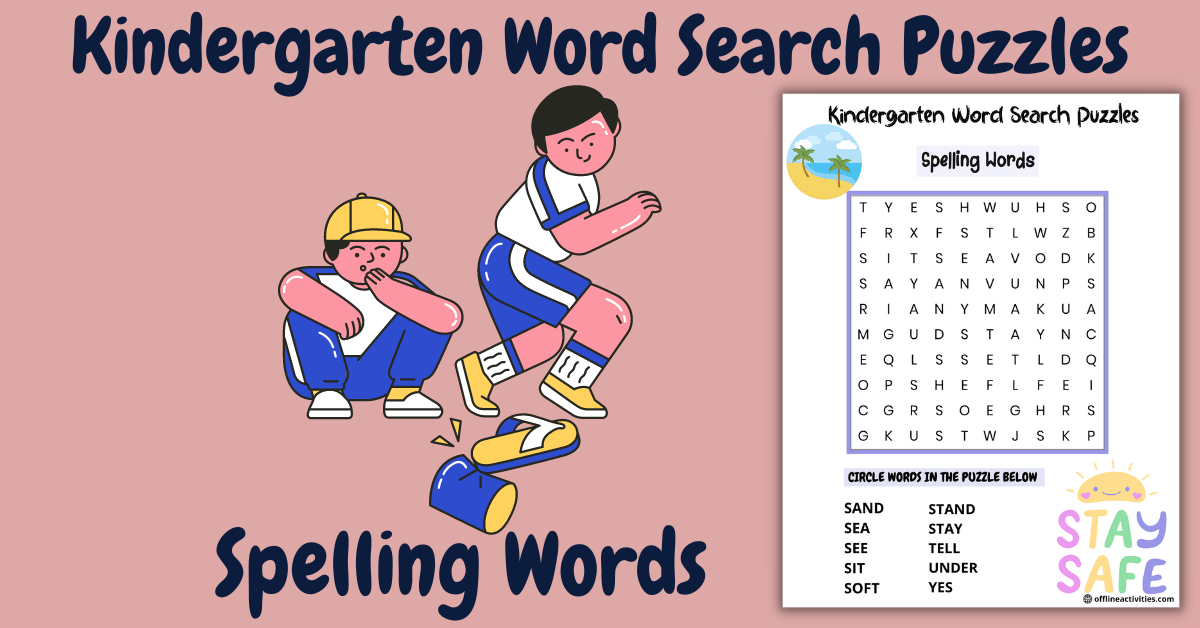
I remember the first time Maya, a quiet kindergartener in my class, confidently pointed to the word “SEE” in a big book. Her eyes widened with recognition—not because she sounded it out, but because she had just spent a joyful morning hunting for it in a word search. That moment of connection, where a playful activity met a tangible reading milestone, is the magic of a simple kindergarten word search printable. This puzzle, built around foundational words like YES, SAND, and UNDER, is designed to do more than pass time. It transforms essential pre-reading practice into a screen-free game of discovery, giving young learners their first thrilling taste of “I can read it myself!”
How to Use This First Word Hunt
Introducing this activity as a playful challenge, not an assignment, is key to success. Here’s how to guide your young learner.
Getting Started is Simple:
Download the clear, child-friendly PDF. Print it on bright paper to make it inviting. For repeated practice (which is excellent for reinforcement), place the sheet in a plastic page protector. Your child can then use chunky dry-erase markers, making the activity reusable and wonderfully tactile.
Guiding the Playful Search:
Sit side-by-side and look at the word list together. Use an excited, gentle voice: “Look at all these word treasures we get to find!” Read each word aloud. For a word like “SOFT,” let them touch something soft. For “UNDER,” play a quick game of hiding a toy under a cup. Then, pick one word to find together first. Model a happy, curious search: “Let’s be detectives and find ‘YES’! It starts with Y—our letter hook!”
Your role is the encouraging coach. Celebrate the process with specific praise: “You’re using your eagle eyes to check every row!” or “I saw you find the ‘S’ in ‘SEA’ all by yourself!”
Adapting for Every Young Learner:
-
For Pre-K or Early Kindergarteners (Ages 4-5): Start with just 3-4 of the shortest, most distinct words, like YES, SIT, and SEE. You can even use a highlighter to mark the starting letter of these words in the grid as a friendly visual clue.
-
For Kindergarteners Building Confidence (Ages 5-6): Use the full puzzle. To connect to phonics, emphasize the beginning sound as they search: “SAND starts with /s/, like snake!”
-
For an Extra Challenge: Ask them to try finding a word without looking at the list, based only on the word you say. Or, see if they can find two words that start with the same letter.
Fun Extension Ideas to Spark Joy:
-
Act It Out: After finding a word like “STAND” or “SIT,” have a mini movement break where you both do the action. This connects the word to its meaning kinesthetically.
-
Sound Match: Once the puzzle is complete, sort the words by their first sound. Put all the “S” words (SAND, SEA, SEE, SIT, SOFT, STAND, STAY) in a group. This builds phonemic awareness.
-
Silly Sentence Maker: Use the found words to create a silly spoken sentence together. “YES, I SEE the SOFT SAND UNDER the SEA!”
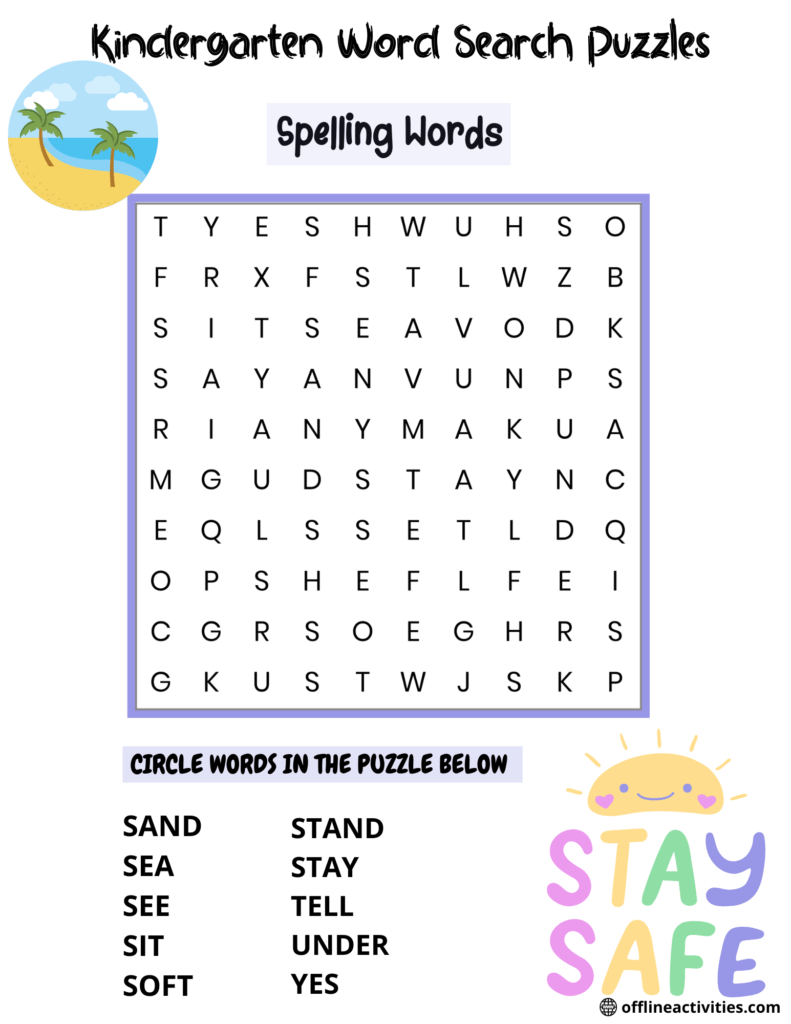
Print Puzzle
The Educational Foundations Behind the Play
In my kindergarten classroom, word searches are a staple in our literacy centers. I use them not just for reading, but as a quiet assessment tool. They allow me to see which children can transfer letter knowledge from isolation to a busy field—a key indicator of early reading readiness. The quiet collaboration as children whisper, “I found YOUR word!” builds a supportive learning community.
From a developmental lens, this activity integrates multiple cognitive processes. It reinforces phonemic awareness by linking sounds to letters. It builds orthographic memory by cementing the visual shape of high-frequency sight words. The task of visually filtering target words from distraction directly exercises selective attention.
This playful approach is deeply aligned with play-based learning and constructivist theories, where children build knowledge through direct, meaningful interaction. It also supports Montessori principles of auto-education, offering a self-correcting material that a child can master independently. Parents and teachers can trust this as a safe, age-appropriate resource that turns critical pre-reading practice into a confidence-building game.
Early Literacy Practice: Word Search vs. Letter Tracing
| Learning Focus | Kindergarten Word Search | Isolated Letter Tracing |
|---|---|---|
| Word-Level Recognition | Teaches the child to see and recognize whole words as single units, a key reading skill. | Focuses on individual letter formation, not on how letters combine to make words. |
| Visual Scanning & Tracking | Actively develops the left-to-right, top-to-bottom eye movements used in reading. | Focuses on fine motor control within a confined space, with less emphasis on visual tracking. |
| Problem-Solving & Persistence | Presents a challenge with a clear payoff, teaching kids to sustain focus and search strategically. | Can become a repetitive motor task without an inherent “puzzle” to solve. |
| Contextual Learning | Presents words amidst other letters, simulating the challenge of finding words in text. | Presents letters in isolation, separate from their function in word-building. |
| Intrinsic Motivation | Often perceived as a fun game or treasure hunt, leading to voluntary engagement. | Can feel more like assigned “work” or practice, requiring more external motivation. |
Frequently Asked Questions
Is my child too young for a word search if they don’t know all their letters?
Not at all! This is a fantastic way to learn letters in context. Focus on the first letter sound as a “clue.” Searching for “SAND” becomes a hunt for the letter S, making letter learning purposeful and fun.
Can this really help a child who is reluctant to try writing?
Yes. The pressure is off to produce letters perfectly. The activity builds the visual memory of the word and strengthens the fine motor skills needed for writing, all within a low-stakes, successful format.
How long should a kindergarten word search take?
Follow the child’s lead. Some may spend 10 focused minutes; others may enjoy coming back to it over two days. The goal is engagement, not speed. Even finding one or two words is a celebrated success.
Is this suitable for classroom use with a wide range of abilities?
Absolutely. It’s perfect for differentiated learning. Some students can work on the full puzzle, while others can have a shortened list. It works well in pairs, fostering peer teaching.
My child just guesses randomly. How can I help?
Gently guide them back to strategy. Say, “Let’s slow down. What’s the FIRST sound in ‘TELL’? Let’s find all the T’s first.” This models the systematic approach readers use.
Do you have other puzzles that focus on different letter sounds?
We offer a variety of thematic and phonics-based printable puzzles that support a structured, screen-free literacy journey, from CVC words to common digraphs.
Planting the Seeds of Reading Confidence
The journey to becoming a reader begins with the simple, powerful belief that words are friendly and discoverable. An activity like this kindergarten word search plants that seed. It’s not about perfection; it’s about the proud smile when a child points and says, “I found it!” That moment is the first chapter in their own story of becoming a reader.
We invite you to download this printable and share it during a cozy moment of connection. It’s a gentle, joyful way to celebrate early literacy and build a positive foundation for all the learning to come.
MORE PUZZLES FOR YOU:
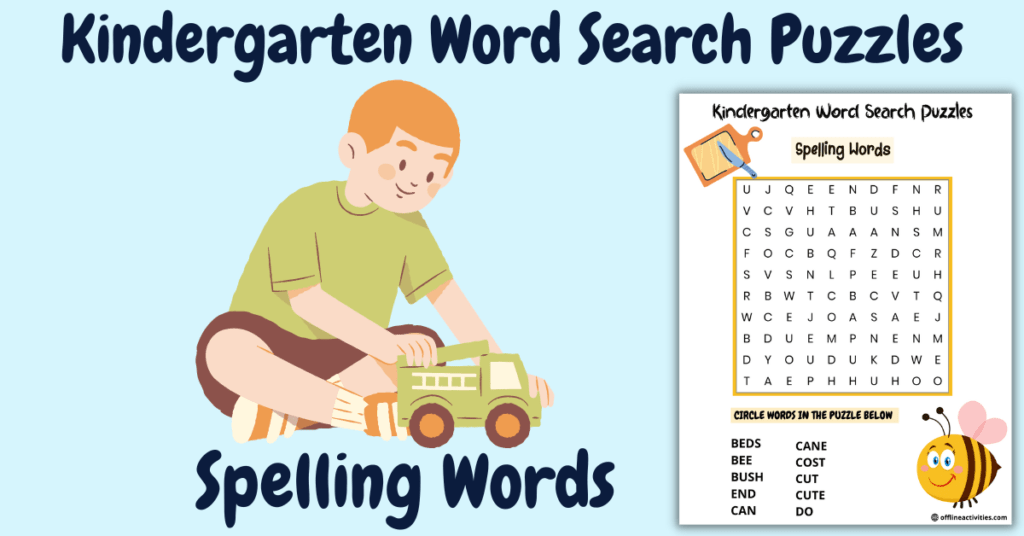
Printable Puzzle – Spelling Words
word searches for kindergarten sight words
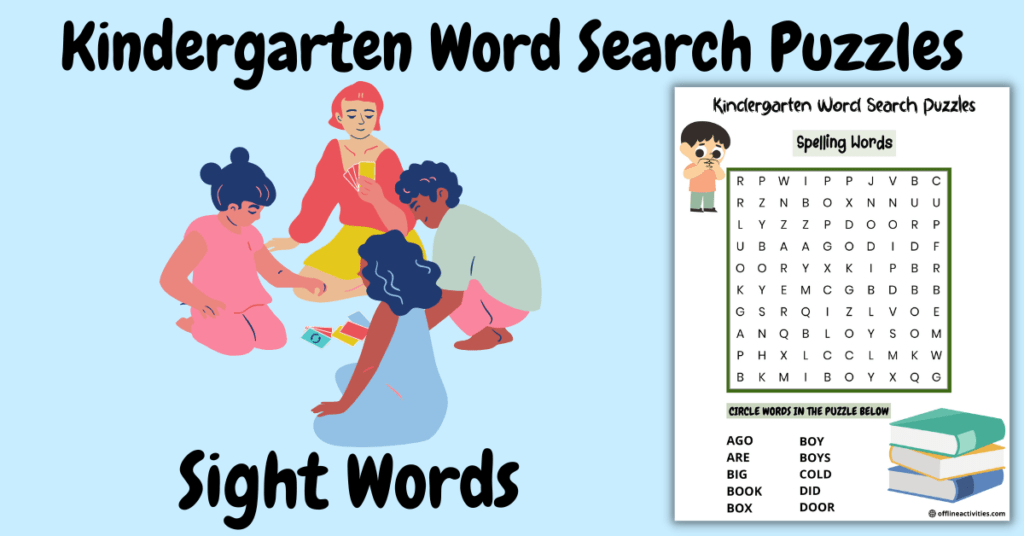
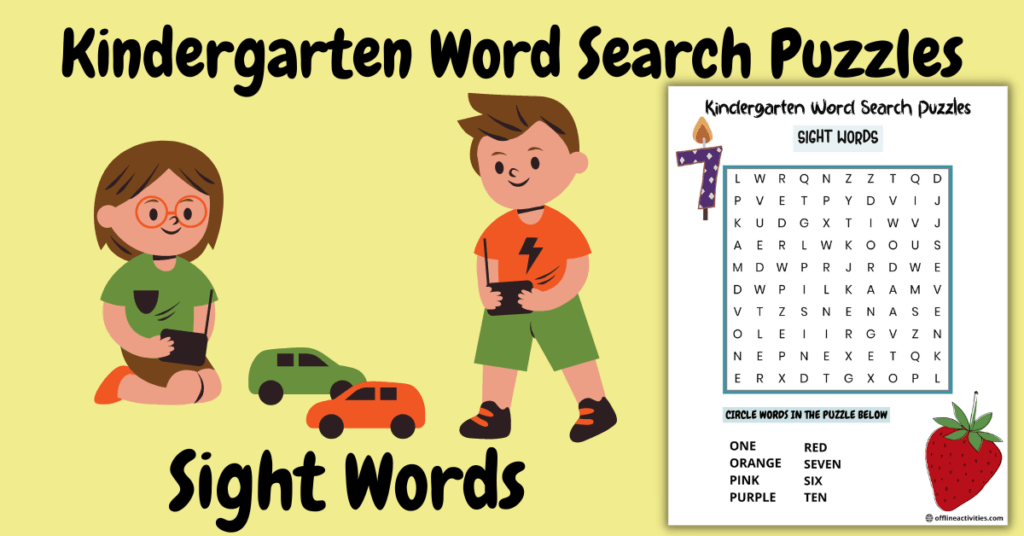
Puzzle Word Search – Sight Words