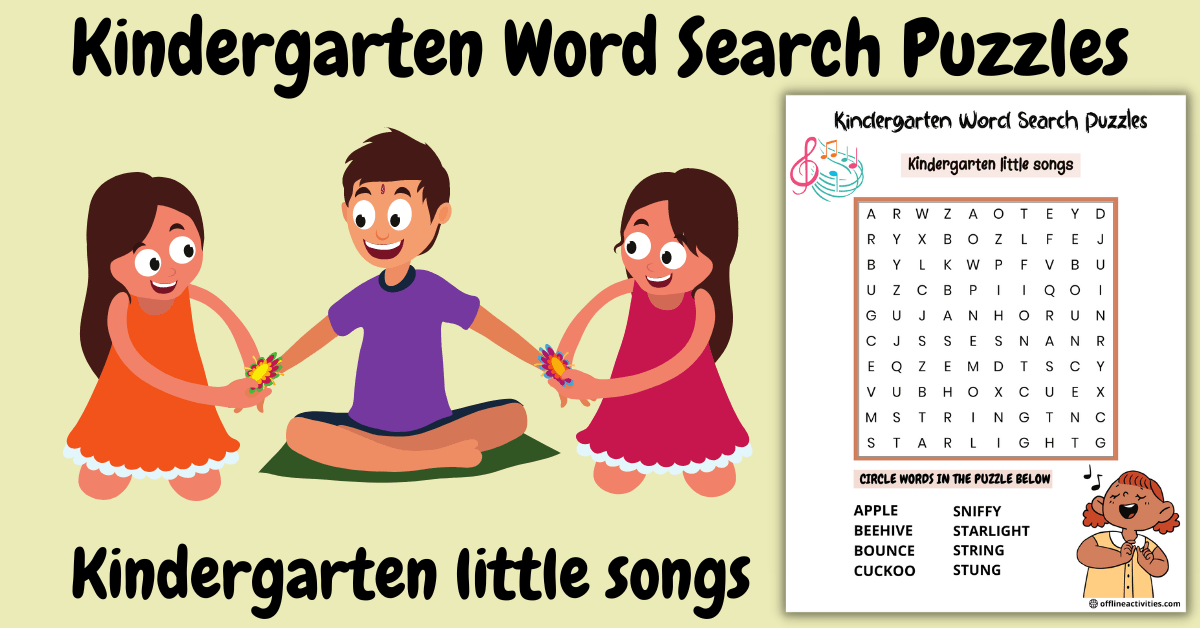
For a kindergarten child, learning feels safest when it starts with something familiar. A word they’ve already sung, clapped to, or heard in a favorite rhyme doesn’t feel new or scary—it feels friendly. When children recognize words connected to songs they love, their confidence grows naturally, without pressure or correction. This is why word search puzzles built around simple songs and rhymes can be so powerful at this age. In this article, you’ll discover how kindergarten word search puzzles inspired by little songs support early literacy, attention, and joyful learning in a calm, screen-free way.
Why This Activity Works
Young children learn best when language, sound, and movement are connected. Word search puzzles based on familiar nursery songs help children strengthen several foundational skills at once. As children look for words, they practice visual scanning and focus, which are essential early reading skills. Matching letters in a grid reinforces letter recognition and helps children notice patterns in print.
Because these puzzles are connected to songs and rhymes, children are not learning words in isolation. They are linking written language to sounds they already know. This connection supports memory and recall, making it easier for children to recognize the same words later in books or classroom activities.
Screen-free activities like word searches also encourage slower, deeper thinking. Instead of fast-paced digital stimulation, children engage in quiet problem-solving that builds patience and self-regulation. Research in early childhood education consistently shows that hands-on paper-based activities help improve attention span and fine motor development in young learners.

Print Puzzle
How to Use the Activity
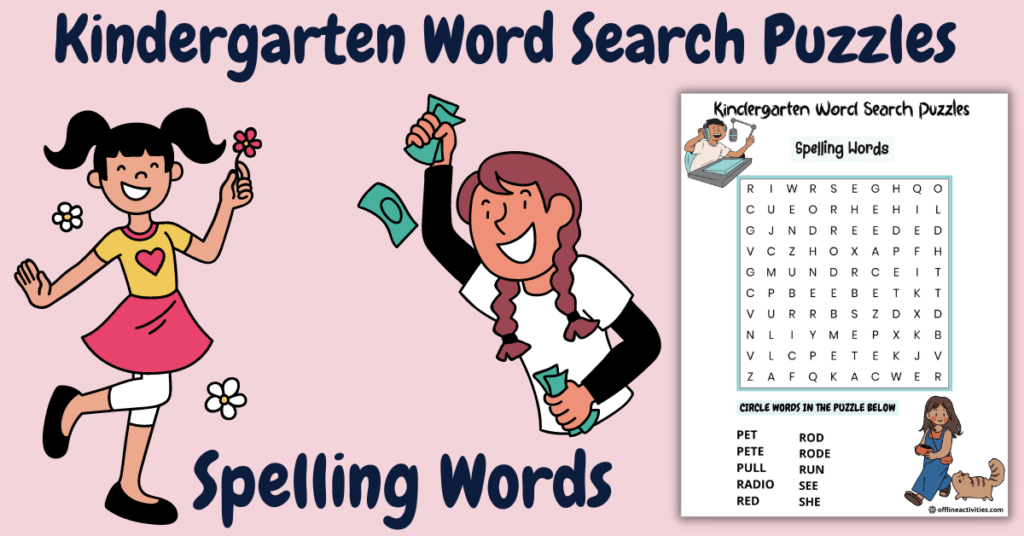
To begin, download and print the kindergarten word search worksheet. Use standard paper and provide crayons or pencils that are comfortable for small hands. Sit with the child at first and read the word list aloud together, allowing them to hear and see each word.
Invite the child to search for just one word at a time. There’s no need to rush. If they seem unsure, gently guide them by pointing to the first letter of the word and asking them to find matching letters in the grid. Keep the tone calm and encouraging.
For younger kindergarten learners, you can highlight the first letter of each word in advance. Older or more confident children may enjoy finding all the words independently. To extend the activity, sing the related song together after each word is found, or ask the child to clap when they recognize a word they’ve seen before.
These puzzles can also be reused. Children often enjoy repeating activities they feel successful with, and repetition strengthens learning.
Educational Foundations
From classroom and home experience, educators know that children engage more deeply when learning feels playful and familiar. Word search puzzles tied to songs reflect how children naturally learn language—through repetition, rhythm, and enjoyment.
From an expertise standpoint, this activity supports early literacy skills such as phonemic awareness, visual discrimination, and early spelling. Children are practicing reading readiness skills without being formally “taught” in a rigid way.
This approach aligns well with Montessori and active learning principles, which emphasize independence, hands-on materials, and self-paced discovery. Children choose how long they engage and experience learning as something positive.
The activity is also trustworthy and safe. It is age-appropriate, screen-free, printable, and designed to support healthy cognitive development without overstimulation.
Printable Worksheets vs Screen Games
Printable Worksheets
Encourage focus and patience
Support fine motor skills
Allow self-paced learning
No screen exposure
Screen Games
Fast-paced and distracting
Limited handwriting practice
Often overstimulating
Require devices and supervision
Frequently Asked Questions
What age is this activity best for?
This word search puzzle is ideal for kindergarten children, typically ages 4–6. It can also be used with preschoolers who recognize letters or first graders who enjoy gentle review.
Can teachers use this in the classroom?
Yes, these puzzles work well for literacy centers, quiet work time, or small-group activities. They are easy to print and adapt for different skill levels.
Is this suitable for ESL learners?
Absolutely. Because the words are connected to songs and simple vocabulary, ESL learners benefit from the visual and auditory reinforcement.
How long does the activity usually take?
Most children complete the puzzle in 10–20 minutes, depending on age and focus. It can also be spread out over multiple short sessions.
How can I make it more engaging?
Pair the puzzle with singing, pointing, or coloring. Allow the child to circle words with different colors or celebrate each word found.
Do children need to know how to read first?
No. Children can participate by recognizing letters and shapes. Reading skills develop gradually through repeated exposure.
Conclusion
Kindergarten learning is most effective when it feels gentle, familiar, and joyful. Word search puzzles inspired by little songs create a bridge between play and literacy, helping children recognize words with confidence and curiosity. Through calm, screen-free practice, children strengthen focus, memory, and early reading skills at their own pace. Download this printable and enjoy a peaceful learning moment built around words your child already loves.
MORE PUZZLES FOR YOU:
Word Search Puzzles Online for Free – Spelling Words
Free Game of Word Search – Spelling Words
Game of Word Search– Spelling Words