
Drawing is one of the most wonderful ways for children to express themselves. It encourages imagination, builds fine motor skills, and gives kids the confidence to create something uniquely their own. And what better place to begin than by learning how to draw a sun — one of the simplest and happiest symbols in children’s artwork?
In this child-friendly guide, parents and teachers will find an easy step-by-step lesson that helps young artists draw a bright, cheerful sun. The steps are simple, the instructions are clear, and the activity is suitable for kids of all ages.
Whether you’re teaching in a classroom, homeschooling, or simply looking for a relaxing weekend activity, this guide will spark creativity, learning, and joy.
☀️ What You’ll Need
Kids can start drawing right away with just a few supplies:
-
A blank sheet of paper
-
A pencil
-
An eraser
-
Colored pencils, crayons, or markers
Once everything is ready, it’s time to bring your sunshine to life!
🌞 Step-by-Step Guide: How to Draw a Sun for Kids
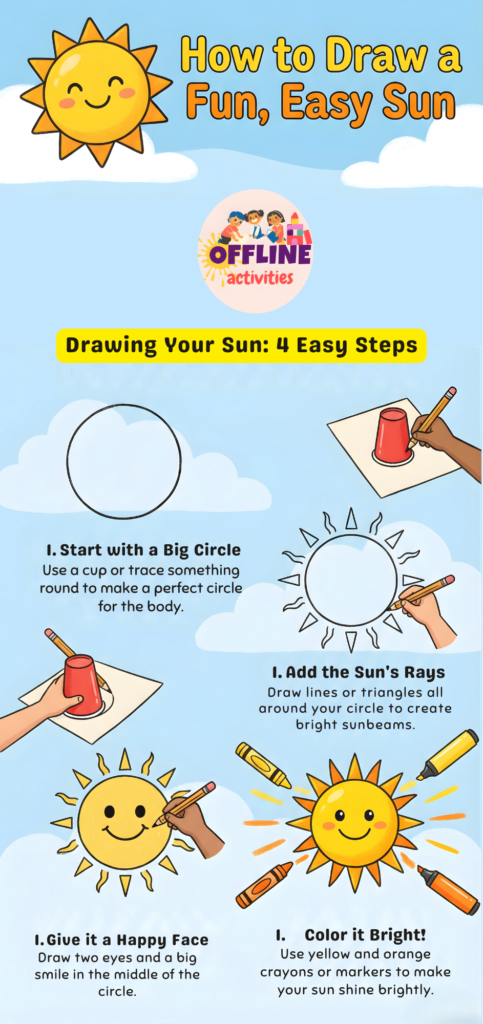
Step 1: Draw a Big Circle
Begin by drawing a large circle in the middle of the page. This will be the main body of the sun. Children who want a perfectly round shape can trace a bowl, lid, or cup.
Skill developed:
Fine motor control and shape recognition.
Step 2: Add a Happy Face
Many children love to give their suns personality! Draw two small circles near the top for eyes, then add a curved line for a big smile. Kids can add eyebrows, eyelashes, or rosy cheeks to make the sun more expressive.
Skill developed:
Emotional expression and creative character design.
Step 3: Draw the Rays
Next, help your sun shine by adding rays all the way around the circle. Kids can experiment by:
-
Drawing straight lines
-
Adding triangles
-
Alternating short and long rays
-
Mixing zig-zags and wavy lines
Every variation helps them create a unique, vibrant sunburst.
Skill developed:
Pattern creation and visual rhythm.
Step 4: Add Fun Details
Encourage kids to decorate the inside of the sun with small swirls, dots, or sparkles. These details make the sun feel personal and whimsical.
Step 5: Color the Sun
This is the step where creativity takes center stage. Kids can use:
-
Yellow for the main sun
-
Orange or red for the rays
-
Pink for cheeks
-
Blue for a sky background
They can blend colors, experiment with shading, or keep it simple and bright.
Step 6: Create a Background
To make the drawing even more exciting, children can add elements like:
-
Fluffy clouds
-
A rainbow
-
Birds
-
Mountains or trees
-
A beach or grassy field
This gives their artwork a story and helps them imagine a whole scene.
Step 7: Final Touches
Encourage kids to check their artwork and gently erase any unnecessary pencil marks. They can outline the final drawing using a black marker for boldness.
🎨 Creative Tips for Young Artists
These simple tips help kids grow as confident creators:
-
Keep practicing — every drawing gets better!
-
Look outside for inspiration: sunrise, sunset, light reflections, shadows.
-
Try drawing suns with different moods — sleepy, silly, excited, magical.
-
Share drawings with friends and family for encouragement.
Drawing is about expression, not perfection. Let kids enjoy the journey!
🌈 Fun Ways to Boost Kids’ Drawing Skills
Beyond drawing a sun, there are countless ways to help children explore creativity. These activities are perfect for developing motor skills, imagination, and artistic confidence.
✏️ 1. Creative Drawing Prompts
Give your child a fun challenge, such as:
-
“Draw your favorite animal doing something funny.”
-
“Design your own planet.”
-
“Create a superhero with unique abilities.”
-
“Illustrate a scene from your favorite book.”
Prompts encourage storytelling and independent thinking.
🖍️ 2. Use Different Art Mediums
Introduce a variety of drawing tools to spark curiosity:
-
Crayons
-
Colored pencils
-
Markers
-
Gel pens
-
Watercolors
-
Pastels
-
Mixed media scraps (fabric, stickers, paper shapes)
Trying new materials helps children discover their artistic preferences.
🎨 3. Set Up a Special Drawing Corner
A dedicated creative space motivates children to draw more often. Include:
-
A small table
-
Good lighting
-
Storage bins for art supplies
-
Motivational posters or artwork
A cozy, organized space makes creativity feel natural.
🌿 4. Encourage Drawing from Real Life
This improves observation and attention to detail.
Try activities such as:
-
Sketching flowers, leaves, or rocks
-
Drawing pets
-
Creating portraits of family members
-
Observing and sketching objects around the house
Children learn to see the world with an artist’s eye.
👪 5. Draw Together
Children love when adults join them. Drawing together:
-
Builds confidence
-
Creates bonding moments
-
Encourages conversation
-
Shows kids that their interests matter
Make a weekly family “art night” for extra fun.
💻 6. Use Safe Online Resources
When screen time is structured and educational, it can support learning. Explore:
-
Step-by-step drawing videos
-
Printable coloring sheets
-
Simple drawing apps for kids
Mixing traditional and digital art can expand their skills while keeping learning enjoyable.
⭐ 7. Celebrate Their Artwork
Children thrive when their work is appreciated. Try:
-
Displaying drawings on a wall or fridge
-
Hosting a small “home gallery”
-
Sending artwork to grandparents
-
Taking photos of their art for a scrapbook
Celebration fosters pride and encourages progress.
🎒 Why Art Matters in Childhood Development
Art is much more than a hobby — it’s a powerful developmental tool.
✔ Boosts creativity
✔ Improves fine motor skills
✔ Strengthens emotional expression
✔ Builds confidence
✔ Enhances focus and patience
✔ Encourages problem-solving
✔ Improves communication skills
✔ Supports mental well-being
Art allows children to explore and understand the world at their own pace.
🎨 Creative Activities to Inspire Young Artists
Here are a few more engaging ideas parents and teachers can use:
🍃 Nature Drawing Adventures
Bring sketchbooks outdoors! Children love drawing:
-
Trees
-
Clouds
-
Birds
-
Flowers
-
Stones
This strengthens observation and appreciation for nature.
♻️DIY Art Supplies
Kids can make their own tools:
-
Potato stamps
-
Textured brushes
-
Recycled cardboard canvases
This teaches resourcefulness and creativity.
🎁 Mystery Art Box
Fill a box with surprise materials and challenge kids to create something using only what’s inside. It promotes imagination and problem-solving.
🎶 Music-Inspired Art
Play different songs and let kids draw what the music makes them feel. Calm music might inspire soft colors; fast music may inspire bright, bold strokes.
📚 Story-Based Drawing
Ask kids to draw:
-
Their favorite story character
-
A scene from a book
-
A brand-new ending
This enhances comprehension and imagination.
🖼️ Host a Mini Art Show
Display artwork in the living room or classroom. Invite others to admire their creativity. It builds confidence and gives kids a sense of accomplishment.
🧑🎨 Tips for Parents to Support Artistic Growth
Parents play an essential role in nurturing creativity. Here’s how to help:
-
Offer many different art materials
-
Encourage experimentation
-
Avoid correcting — instead, ask open questions like “Tell me about your drawing!”
-
Celebrate effort more than results
-
Limit screen time to encourage hands-on activities
-
Show enthusiasm and participate when possible
-
Visit museums or craft fairs together
-
Be patient — artistic skills grow slowly and beautifully
Supporting art encourages children to express themselves, develop confidence, and think creatively.
🌟 Conclusion: Let Their Creativity Shine
Learning how to draw a sun is just the beginning. With every circle, every ray, and every splash of color, children build confidence, imagination, and artistic skill. Drawing empowers kids to express themselves and explore the world around them.
Support their creativity. Celebrate their art. Give them the tools to shine — just like the bright sun they’ve drawn.
Your child’s next masterpiece begins with one simple line. Let the fun begin!
MORE PUZZLES FOR YOU:
Screen Free Activities For 2 Year Olds
How to Motivate Kids to Learn Offline?
How To Encourage Creative Drawing In Young Children
Things To Do Without Technology At Home