During a quiet literacy block, a teacher places a stack of printed word search puzzles on a small group table. Instead of the usual groans that sometimes follow vocabulary drills, there is curiosity. One student points to a name they recognize, another slowly traces letters with a finger, whispering sounds as they go. Moments like this are common in classrooms where learning feels safe and exploratory. These first-grade word search puzzles were created to support exactly that kind of environment—where children can build vocabulary, confidence, and focus without pressure. In this article, you’ll discover how this simple printable activity supports early reading skills and how it can be used effectively both in the classroom and at home.
Why This Activity Works
Word search puzzles work well in early grades because they meet children where they are developmentally. In first grade, students are still strengthening letter recognition, sound blending, and word awareness. Searching for words in a grid allows them to practice these skills in a calm, low-stress way.
This activity helps develop:
• Visual scanning and attention control
• Vocabulary recognition and name familiarity
• Early reading confidence
• Problem-solving and persistence
• Fine-motor coordination through circling or highlighting
Screen-free activities like this one reduce cognitive overload. When students work with paper, their attention is directed toward one task at a time. Many teachers notice that children remain engaged longer and show less frustration when reviewing words through printable puzzles rather than digital games. Simple paper-based tasks also support classroom routines by encouraging quiet focus and independent work.

Print Puzzle
How to Use the Activity
To begin, download and print the worksheet. It is designed in a clean, easy-to-read format suitable for first graders. The puzzle can be printed in black and white and works well with pencils, crayons, or highlighters.
Before students start, introduce the words together. In a classroom, this might be a short group reading where the teacher says each word aloud and students repeat it. At home, parents can ask if the child recognizes any of the names.
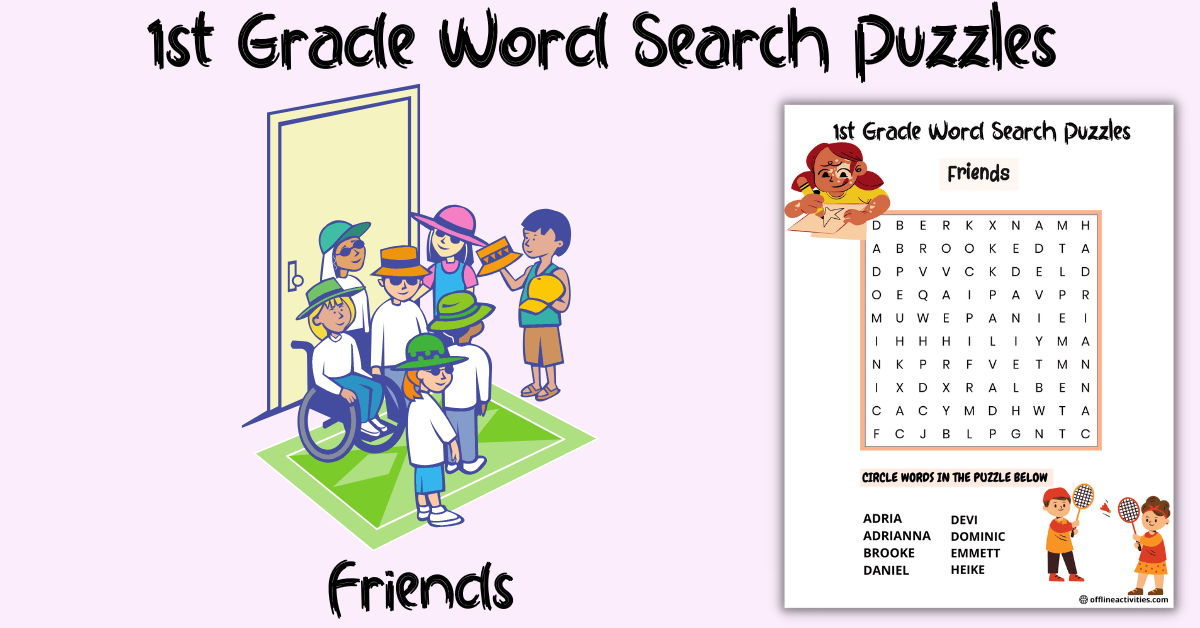
The vocabulary words included in this puzzle are:
ADRIA
ADRIANNA
BROOKE
DANIEL
DEVI
DOMINIC
EMMETT
HEIKE
Encourage students to scan the grid slowly. There is no need to rush. Teachers often walk around the room, offering gentle encouragement rather than corrections. At home, sitting nearby while allowing independence builds confidence.
To adapt the activity by age or ability:
• Beginners can search for two or three words at a time
• More confident readers can complete the entire puzzle independently
• Advanced learners can write each word neatly underneath the puzzle
Fun extensions include asking students to clap syllables in each name, sort names by length, or practice writing them in cursive or print. These variations help deepen language awareness while keeping the activity enjoyable.
Educational Foundations
This activity reflects real classroom experience. Teachers frequently use name-based word searches during the beginning of the school year or in literacy centers because children naturally connect with familiar names. This personal connection increases motivation and engagement.
From an educational expertise standpoint, word search puzzles support orthographic processing, visual memory, and early decoding skills. Children learn to recognize letter patterns and confirm word structures, which are essential for reading fluency.
The approach aligns with Montessori principles of independent work, active learning strategies, and kinesthetic development. Students interact physically with the page, reinforcing learning through movement. The activity is age-appropriate, safe, and designed for repeated use without screens, making it trustworthy for both classroom and home settings.
Printable Word Search Worksheets vs Screen Games
Printable Word Search Worksheets
Encourage sustained focus
Support vocabulary and reading readiness
Strengthen handwriting and fine-motor skills
Low distraction, calm learning environment
Easy to use in classrooms and homes
Screen-Based Games
Often fast-paced
Shorter attention spans
Limited physical interaction
Higher risk of distraction
Frequently Asked Questions
What age group is this activity best for?
This puzzle is ideal for children aged 5–7, especially first graders building early reading and vocabulary skills.
Can teachers use this in the classroom?
Yes. It works well during literacy centers, independent work time, or as a calming transition activity.
Is this suitable for ESL learners?
Yes. Name-based vocabulary helps ESL learners practice letter recognition and pronunciation in a friendly context.
How long does the activity usually take?
Most students complete the puzzle in 10–15 minutes, depending on focus and familiarity with the words.
How can I make this more engaging?
You can allow students to color-code words, read them aloud, or create a short story using one of the names.
Can this worksheet be reused?
Yes. Laminating the page or using a plastic sleeve allows repeated use with dry-erase markers.
Conclusion
In classrooms, the most effective learning moments are often the quiet ones—when students are focused, curious, and working at their own pace. These first-grade word search puzzles provide that kind of experience. By combining vocabulary practice with problem-solving and calm engagement, this printable supports both learning and confidence. Whether used in a classroom literacy block or at the kitchen table at home, it offers a meaningful, screen-free way to explore words. Download this printable and create a focused, enjoyable learning moment for your child or students today.
MORE PUZZLES FOR YOU:
1st Grade Word Search Puzzles- Friends

1st Grade Word Search Puzzles- Friends

1st Grade Word Search Puzzles- spelling Word