
Imagine your child curled up on the couch, not with a tablet, but with a piece of paper and a pencil. Their brow is furrowed in sweet concentration, their finger tracing a path across a grid of letters. They are on a quest, not in a digital world, but in a quiet world of words. This simple scene is where a love for language often begins. Our first grade word search printable, featuring gentle words like “SEE,” “PLAY,” and “MY,” is designed to be the starting point for that story. It’s more than a worksheet; it’s an invitation for your child to become an explorer, discovering the fundamental words that will help them tell their own tales.
Why This Story of Words Activity Works
Every great reader starts by falling in love with the building blocks of stories. This word search is carefully crafted to build that affection through success. As children search for deeply personal words like “ME,” “MY,” and “SHE,” they are doing the important work of connecting language to their own world. This emotional connection makes the learning stick, transforming abstract letters into meaningful symbols.
The activity itself is a quiet adventure in visual perception. Finding “LOOK” and “SEE” in a jungle of letters trains a child’s eyes to scan and differentiate, a critical pre-reading skill that builds focus and attention to detail. The careful act of circling each found word also nurtures the fine motor control needed for writing. By offering this journey in a screen-free format, we give a child’s imagination the primary role. Without flashing lights or automated rewards, the satisfaction comes purely from within—a powerful lesson in intrinsic motivation. Educators note that this kind of self-directed, tactile activity builds stronger cognitive pathways for memory than passive watching or listening.

Print Puzzle
How to Begin Your Child’s Word Story
Setting the stage for this activity can turn it from a task into a treasured ritual. Here’s how to guide your young word explorer.
Starting the Adventure:
Download the clear, welcoming PDF. For a special touch, print it on their favorite color of paper. To make this a story they can revisit, place the sheet inside a plastic sleeve. They can then use dry-erase markers, allowing the tale to be told again and again with a simple wipe.
Guiding the Exploration:
Sit together and read the word list like you’re reading a map of treasures. Use a warm, storytelling voice. “Oh, look! Here’s ‘ME.’ And here’s ‘MY.’ These are words all about you!” Then, choose a word to search for together. Make it playful: “Let’s go on a hunt for ‘PLAY.’ Where could it be hiding?” Your role is the encouraging guide on the side. Celebrate the process with phrases like, “You’re such a careful detective,” or “I saw you not give up on finding ‘SAID.’ That’s how explorers do it!”
Adapting the Quest for Every Young Learner:
-
For the Beginning Explorer (Ages 5-6): Start the story with just a few key characters. Focus on finding “ME,” “MY,” “SEE,” and “THE.” You can even draw a tiny smiley face next to the first letter of each word in the grid as a friendly clue.
-
For the Growing Reader (Ages 6-7): Embark on the full quest. To deepen the story, ask your child to whisper a sentence using each word they circle. “I SEE MY SHE.”
-
For the Confident Storyteller: Challenge them to find all the words without the list. Or, after completing the puzzle, see if they can tell a short story using every single word they found.
Expanding the Narrative:
-
Sentence Weavers: Turn each found word into a story bead. After circling “LIKE,” ask, “What do YOU like?” and help them form a full sentence. This builds from word recognition to self-expression.
-
Word Character Creation: Have your child draw a little picture for words that are easy to illustrate, like “SHE,” “PLAY,” or “SEE.” This creates a visual dictionary of their new word friends.
-
The Cooperative Tale: Take turns finding words. You find “THE,” they find “MY,” and together you build a spoken sentence as you go.
The Educational Heart of the Story
In my years of sharing stories with children, I’ve seen how an activity like this weaves together the technical and the magical. It’s a tool that allows a child to practice the mechanics of reading—letter recognition, left-to-right tracking, and sight word fluency—within a framework that feels personal and playful, not like a drill.
From a developmental perspective, this puzzle strengthens phonemic awareness by linking the sounds in “SAID” to its unexpected spelling. It actively builds orthographic memory, cementing the visual image of high-frequency words that are the glue of every sentence. The self-paced, hands-on nature of the search is a core principle of active learning, where knowledge is constructed through direct experience. It also beautifully aligns with a Montessori respect for the child’s concentration and mastery, offering a self-correcting material that provides both challenge and achievable success. You can trust this as a safe, gentle, and profoundly effective way to nurture early literacy without a single screen.
Two Ways to Learn Words: A Tale of Two Methods
| The Learning Journey | Word Search Storytelling | Digital Word-Matching Game |
|---|---|---|
| Pace & Atmosphere | Child-controlled, calm, and reflective. Allows for pauses, questions, and personal connection. | Often fast-paced, timer-driven, and designed with stimulating sounds that dictate the rhythm. |
| Sensory Experience | Tactile and visual. Involves the feel of paper, the grip of a pencil, and the full visual field of the page. | Primarily visual and auditory through a glass screen, with limited tactile feedback beyond tapping. |
| Connection to Real Reading | Mirrors the quiet, focused activity of sitting with a book and visually processing text on a page. | Uses game mechanics (swipes, pops, rewards) that are unrelated to the act of reading physical text. |
| Narrative & Meaning | Easily integrated into conversation, storytelling, and personal reflection, making words meaningful. | Often focuses on speed and accuracy within the game’s context, with less emphasis on personal word meaning. |
| The Ending | Creates a tangible artifact—a completed paper they can hold, display, and feel proud of. | Ends with a digital score or transition to the next level, leaving no physical record of accomplishment. |
Frequently Asked Questions
What makes these specific words a good “story”?
These words are the heart of early self-expression and narrative. “I,” “me,” “my,” “she,” “like,” “see,” and “play” are the words children use to talk about their world. Learning them empowers them to “read” their own lives.
My child gets frustrated easily. How can this help?
The puzzle format is wonderfully forgiving. There’s no “wrong” way to search, and you can always offer to be a looking buddy. Start with just one or two words to build an immediate “I did it!” moment that outweighs any frustration.
Can this be part of a bedtime wind-down routine?
Absolutely. Its screen-free, calm nature makes it a perfect alternative to bright screens before bed. It’s a focused, quiet activity that can help settle an active mind.
How does this prepare my child for writing?
By solidifying the correct spelling of these common words in their visual memory, you are building the internal word bank they will draw from when they begin to write sentences. Knowing “THE” and “SAID” by sight is a huge advantage for a young writer.
Is there a right or wrong way to search?
Not at all! Some children search row by row; others look for specific letters. Both are valid strategies. Part of the fun is watching your child develop their own unique problem-solving story.
Do you have other printables that continue this word-story theme?
We have a whole library of resources that build on these first narrative words, introducing verbs, adjectives, and thematic vocabulary to help children tell richer and richer stories, all through calm, printable play.
Every Child’s Reading Story Begins Somewhere
The journey to becoming a reader is the most important story we help a child write for themselves. It’s built on moments of curiosity, flashes of understanding, and the quiet pride of figuring something out. This first grade word search is a gentle first chapter in that story. It’s not about pressure or performance; it’s about the joyful discovery that words are everywhere, waiting to be found, and that they have the power to describe a world that is uniquely theirs.
We hope you’ll download this printable and share it with your young learner. Let it be the start of a beautiful, screen-free story about the magic of words.
MORE PUZZLES FOR YOU:
1st Grade Word Search Puzzles- Welcome to First Grade
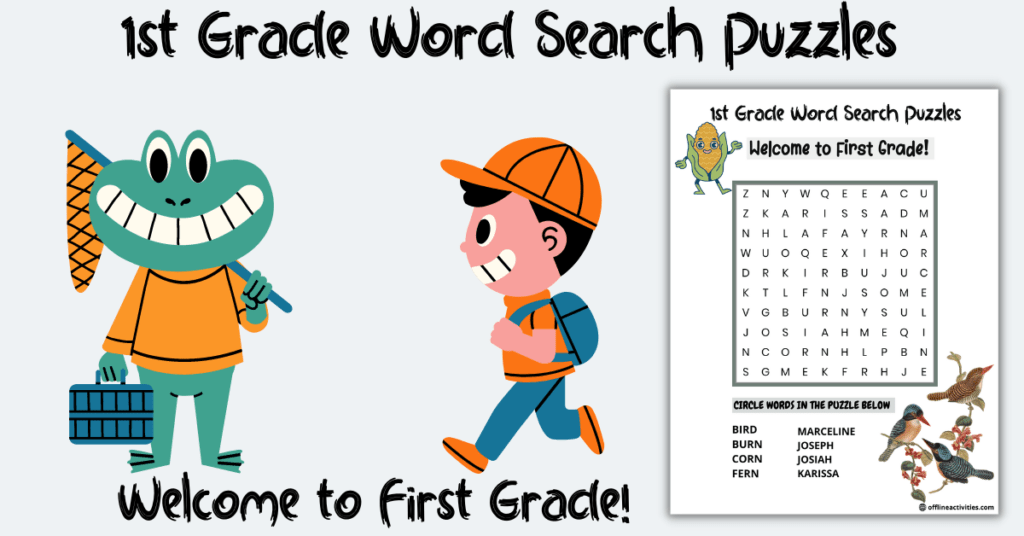
1st Grade Word Search Puzzles- Welcome to First Grade!

Word Search Games Free- First Grade Words
