During early reading lessons, there is often a quiet moment when a child pauses, scans a page, and tries to remember how a word looks rather than how it sounds. As teachers and parents, we see this moment often—it’s when spelling is starting to move from memorization to real understanding. At this stage, children need practice that feels supportive, not overwhelming. Printable word search puzzles offer exactly that kind of learning space. This 1st grade word search activity helps children strengthen spelling skills, focus, and confidence through calm, screen-free practice. In this article, you’ll learn how this printable supports early spelling development and how to use it effectively at home or in the classroom.

Print Puzzle
Why This Activity Works
Word search puzzles encourage children to slow down and truly look at words. Instead of rushing to finish, they must scan carefully, recognize letter patterns, and confirm spelling visually.
This activity helps build:
• Spelling recognition and visual memory
• Focus and sustained attention
• Problem-solving and logical thinking
• Fine-motor control through circling and marking
• Confidence through independent completion
Because this activity is screen-free, children are able to concentrate without digital distractions. Educational observations consistently show that paper-based puzzles help young learners maintain focus longer and recall spelling words more effectively than fast-paced screen activities.
How to Use the Activity at Home or in the Classroom
Download and Print
Download the printable word search worksheet and print one copy for each child. Black-and-white printing works perfectly, and you may print extra copies for repeated practice or small groups.
Introduce the Spelling Words
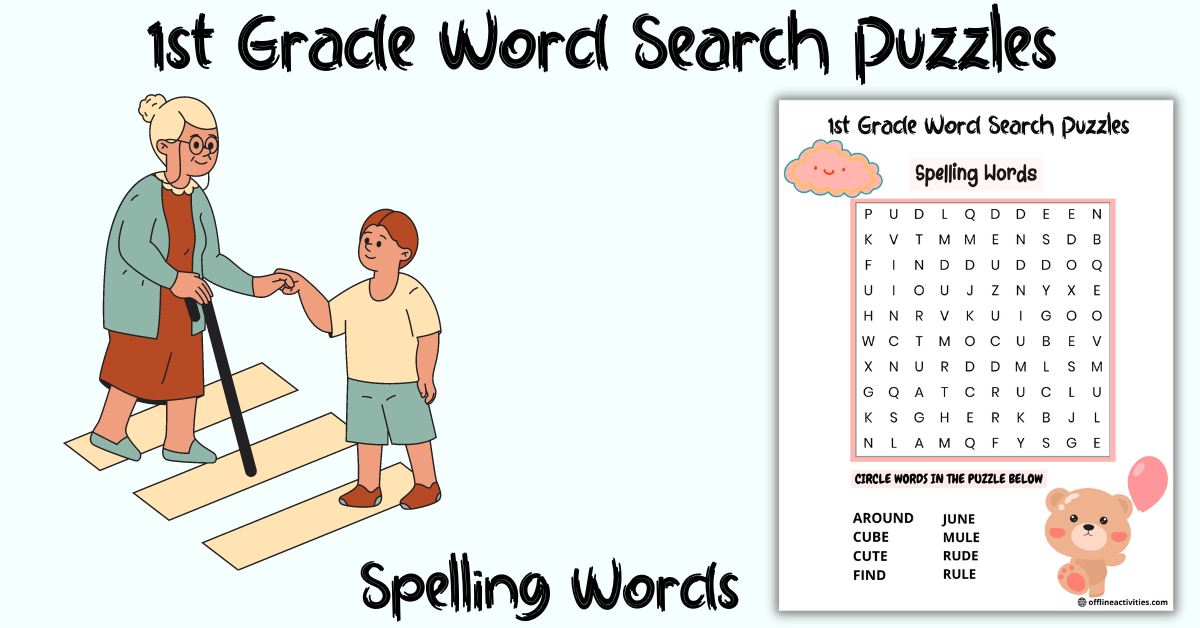
Before starting the puzzle, read the spelling words together. The words included in this activity are:
AROUND
CUBE
CUTE
FIND
JUNE
MULE
RUDE
RULE
Reading the words aloud helps children feel prepared. You can ask gentle questions such as, “Which word looks the longest?” or “Do you notice words that end the same way?”
Guide the Child Calmly
Encourage slow, careful searching. Allow the child to circle or mark each word once it is found. Avoid correcting too quickly—discovery and confidence are more important than speed.
Adapt the Difficulty by Age
For ages 5–6, search together and name letters aloud.
For ages 6–7, encourage independent searching with light guidance.
For ages 7–8, extend the activity by writing sentences using each word.
Extend the Learning
To deepen engagement, try these simple ideas:
• Sort the words by length
• Identify rhyming words like “cube” and “mule”
• Draw a picture that matches one word
• Create a short oral story using two or three words
Educational Foundations You Can Trust
Experience
In early elementary classrooms, word search puzzles are often chosen during quiet learning times because children feel relaxed, capable, and motivated to finish the task.
Expertise
This activity strengthens orthographic mapping, helping children connect written words with meaning. It also supports working memory, visual discrimination, and early spelling accuracy.
Authority
The design aligns with Montessori-inspired independent work, active learning approaches, and kinesthetic development through hands-on interaction.
Trustworthiness
This printable is safe, age-appropriate, and completely screen-free. It contains no ads within the worksheet and offers clear guidance for parents and teachers.
Printable Word Search vs Screen-Based Games
Printable Word Search
Builds sustained focus
Supports spelling and reading skills
Encourages fine-motor development
Calm, distraction-free learning
Suitable for classroom and home use
Screen-Based Games
Short attention spans
Often overstimulating
Limited handwriting practice
Less transferable spelling skills
Frequently Asked Questions
What age is this activity best for?
This printable is ideal for children aged 5–8, especially first graders developing spelling confidence.
Can teachers use this worksheet in class?
Yes. It works well for literacy centers, small-group activities, and independent practice.
Is this suitable for ESL learners?
Yes. Visual repetition and structured word searching support early English language development.
How long does the activity take?
Most children complete the puzzle in about 10–15 minutes.
How can I make it more engaging?
You can add colors, movement-based extensions, or follow the puzzle with drawing or sentence writing.
Can the worksheet be reused?
Yes. Laminating the page or using a plastic sleeve allows children to reuse it multiple times.
Conclusion
Spelling practice does not need to feel rushed or repetitive. With thoughtfully designed word search puzzles, children can strengthen spelling skills, focus, and confidence in a calm and supportive way. Activities like this printable word search allow children to practice at their own pace while enjoying the learning process.
Every word a child finds supports not only spelling development, but also patience, attention, and self-confidence.
Download this printable and start a calm, screen-free learning moment today.
MORE PUZZLES FOR YOU:
Game of Word Search- Spelling Words
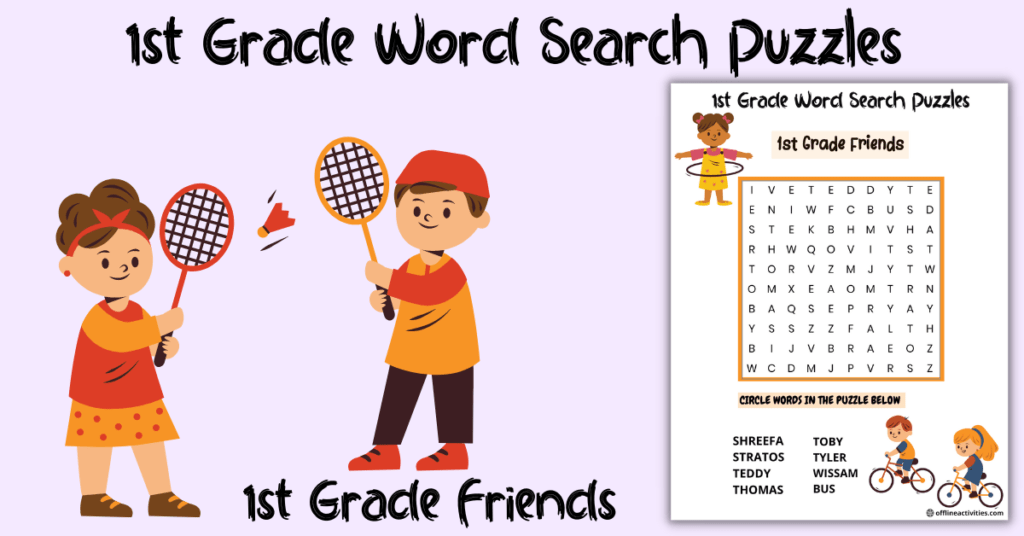
Word Search Large Print Free Printable- 1st Grade Friends
Word Searches Printable- Spelling Word