Have you noticed how first graders can recognize a word one day… and forget it the next?
That’s completely normal. At this age, children don’t just need exposure to sight words — they need calm repetition in a playful way. A free game of word search for spelling words offers exactly that: practice that feels like a game, not a lesson.
This printable word search activity helps first graders strengthen reading skills, focus longer, and feel proud of their progress. In this guide, you’ll learn why this activity works so well, how to use it step by step, and where to download the printable along with free bonus worksheets for offline learning.
Print Puzzle
Why This Activity Works: Targeted Phonics Practice
This isn’t a random list of words; it’s a strategically curated puzzle targeting specific early literacy hurdles.
-
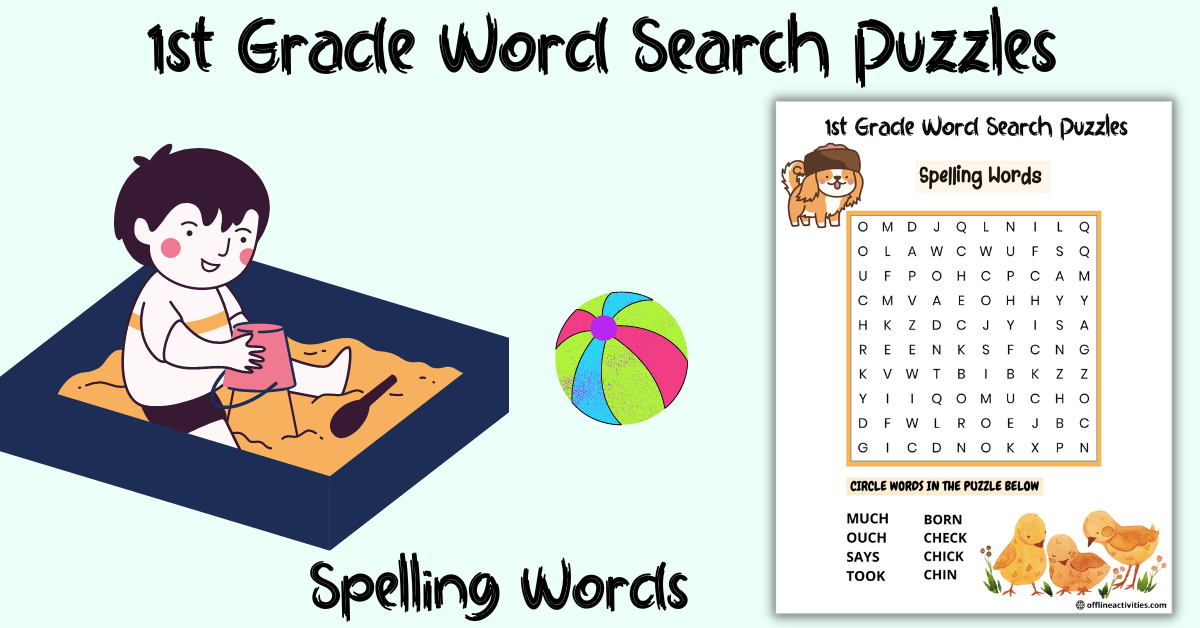
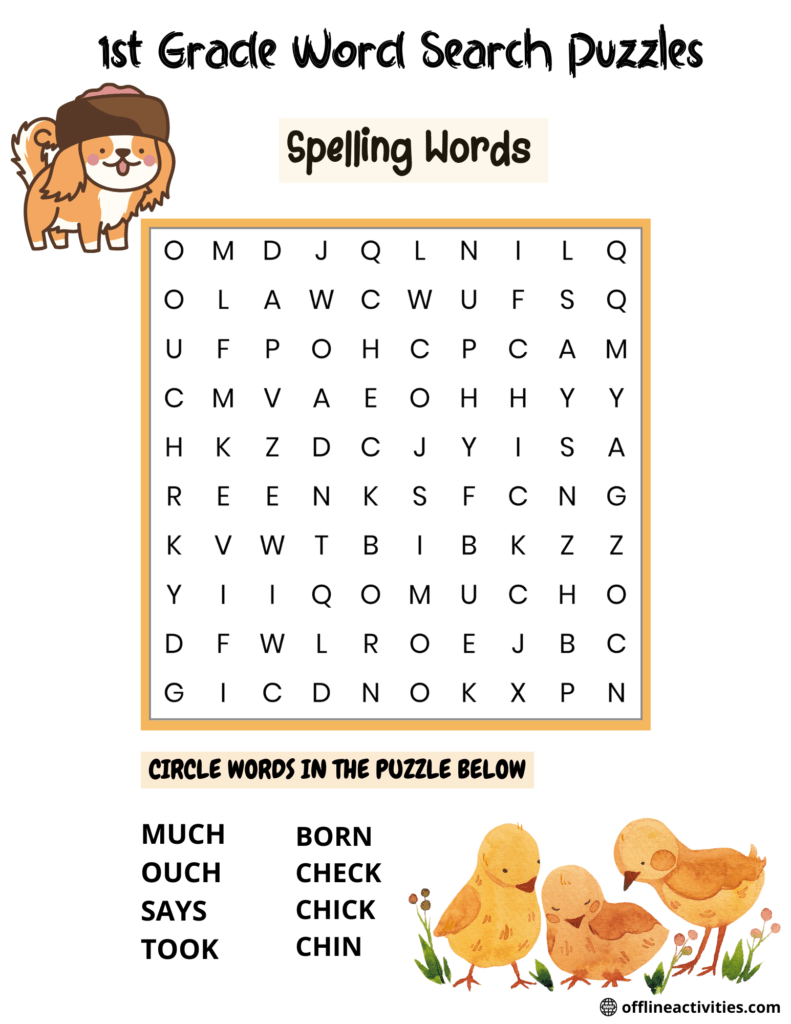
Builds Phonemic Awareness: Words like OUCH, CHICK, and CHECK highlight distinct digraphs (CH, CK) and vowel sounds, training the ear and eye to recognize common phonetic patterns.
-
Reinforces Irregular Sight Words: Mastering high-frequency but irregular words like SAYS, MUCH, and TOOK by sight is crucial for reading fluency. This search provides low-pressure, repetitive exposure.
-
Develops Orthographic Mapping: The act of searching for the letter sequence in “BORN” versus “CHIN” helps children internalize spelling patterns, moving words from short-term to long-term memory.
-
Promotes Sustained, Offline Focus: Completing a physical puzzle requires a depth of concentration that fragmented screen games often disrupt, building the attention stamina needed for independent reading.
A Key Fact: A 2022 study in the Journal of Educational Psychology found that targeted, game-based phonics practice can improve word recognition accuracy in early readers by up to 30% compared to rote memorization alone.
Your Step-by-Step Guide to Phonics Success
Let’s transform this printable from a simple sheet into a powerful learning session. Your role is that of a supportive coach guiding their detective.
Step 1: Download, Print & Prepare
-
Get Your Tool: Use the link above to download the high-resolution PDF. For best results, print on standard letter-size paper.
-
Create a Reusable Center: For endless practice, slip the printed page into a clear plastic sheet protector. Your child can use a dry-erase marker to circle words, making it perfect for classrooms or repeated use at home.
-
(You’ll need dry-erase markers and plastic sleeves to reuse this printable, creating a durable, cost-effective resource.)
-
Step 2: Introduce with a “Sound Detective” Mission
Frame the activity as a phonics investigation. “We have a mission, Detective! We need to find words that hold secret sounds. Some have the /ch/ sound like CHIN, others have the /ck/ sound like CHECK. Let’s read our target list and listen for those sounds first.”
Step 3: Guide the Search with a Phonics Focus
-
For Beginners (Ages 5-6): Focus on one sound at a time. “Let’s be /ch/ hunters! Can you find CHIN, CHICK, and MUCH? They all have our secret sound.” Help them by circling the “ch” or “ck” in the word list.
-
For Developing Readers (Ages 6-7): Challenge them to find words independently, but group them by sound afterwards. “Great! Now, which of the words you found have the same ending sound as CHECK?” (TOOK, CHICK).
-
For Confident Readers (Age 7+): Ask them to find all words with short vowels first. Have them create a “Tricky Word” list for words that don’t follow simple rules (SAYS, AARON).
Step 4: Creative Extensions to Master the Patterns
-
“Sound Sort” Challenge: After finding all words, use the included “Sound Detective” bonus sheets to sort them. Create columns for “CH Words,” “CK Words,” “Tricky Words,” and “OR Words” (BORN). This active learning strategy is a cornerstone of structured literacy.
-
Kinesthetic Word Building: Use letter tiles or magnets. After finding OUCH, have them build it, then change the ‘O’ to a ‘C’ to make CUCH—a nonsense word that reinforces the -CH pattern through play.
-
Sentence Scoop: Write each found word on a scrap of paper, fold it, and put it in a bowl. Have your child pick two and create a spoken sentence. “AARON says OUCH!” This builds vocabulary and grammar in a playful, pressure-free way.
The Educational Context: Precision Learning Through Play
Experience: In my reading intervention sessions, this targeted approach is a game-changer. I’ve seen children’s eyes light up with understanding when they group CHECK, CHICK, and TOOK together and hear the shared ending sound—it’s the moment phonics “clicks.”
Expertise: This activity directly builds phonological awareness (hearing sounds) and orthographic mapping (linking sounds to letters). It engages both auditory and visual processing pathways, creating stronger neural connections for word recognition.
Authority: The design is rooted in the Science of Reading, specifically the systematic phonics approach. It also utilizes the Montessori “Three-Period Lesson” principle: 1. Naming the words/sounds, 2. Recognizing them (finding them), 3. Recalling them (sorting/building).
Trustworthiness: The word list is intentionally selected to address common early reading challenges. The instructions prioritize a positive, “mistake-friendly” environment where exploring sounds is the goal, not just getting the right answer.
Targeted Phonics Search vs. Generic Screen Game
| Learning Dimension | “Short Vowel Spy” Printable Search | Generic Tablet Phonics App |
|---|---|---|
| Instructional Focus | Deep, analytical pattern recognition. Groups words by sound/spelling for conceptual understanding. | Often isolated, rapid-fire letter-sound matching. May lack explicit pattern grouping. |
| Cognitive Engagement | Active comparison and categorization. Child must analyze and sort words they find. | Often passive recognition; the app provides the categories and feedback. |
| Pace & Stamina | Self-paced, encourages sustained attention on a single page to complete a full task. | App-controlled pace, often designed for short bursts with frequent rewards. |
| Skill Transfer | Directly transfers to spelling tests and decoding new words in books. (“If I know OUCH, I can read COUCH.”) | Game mechanics may become the focus; transfer to offline reading/writing can be less direct. |
| Outcome | A completed map of sound patterns. The child creates a physical reference of their learning. | Points, levels, or digital stickers. The learning artifact is intangible. |
Frequently Asked Questions (FAQ)
Q: What age/grade is this word search for?
A: It is perfect for children ages 5-7, typically in late Kindergarten, First Grade, or as a review for struggling Second Grade readers. It targets the specific phonics patterns taught at this stage.
Q: Can I use this in my classroom for differentiated learning?
A: Absolutely. It’s an ideal resource for literacy stations. You can assign it to a group focusing on digraphs (CH/CK) or as independent practice for sight words. Laminating a set makes it a durable center year after year.
Q: My child gets bored with worksheets. How can I make this more fun?
A: Turn it into a race against a gentle timer (e.g., “Can you find all the /ch/ words in 60 seconds?”). Use dot markers or scented highlighters. Hide the worksheet around the room and have them find it before they find the words!
Q: My child finds it too easy. How can I extend it?
A: Excellent! Have them turn the page over. Challenge them to write a definition for “MUCH” and “SAYS.” Ask them to think of and spell two more words that end with the /k/ sound spelled -CK. This builds vocabulary and advanced spelling skills.
Q: Where can I find more phonics-focused printables?
A: By downloading this free pack, you’re joining our community dedicated to evidence-based, screen-free literacy tools. We regularly release new printables targeting specific skills like vowel teams, blends, and word families.
Conclusion: Building the Decoder’s Toolkit
This free printable puzzle is a precise tool in your child’s literacy toolkit. It moves beyond simple word recognition to build the analytical phonics skills that empower children to tackle unfamiliar words with confidence. It proves that with the right focus, practice can be both powerful and playful.
Every sound pattern uncovered builds not just a word list—but the strategic skill of a confident, independent reader.
📚 Empower Your Child’s Decoding Skills Today!
Download the FREE “Short Vowel Spy” Word Search Now. You’ll get instant access to this targeted phonics tool and creative extensions to make foundational skills stick. Let’s turn reading roadblocks into building blocks!
MORE PUZZLES FOR YOU:
Word Find Search- Friends

Word Search Game Online for Free
Puzzle Find the Words- spelling Word