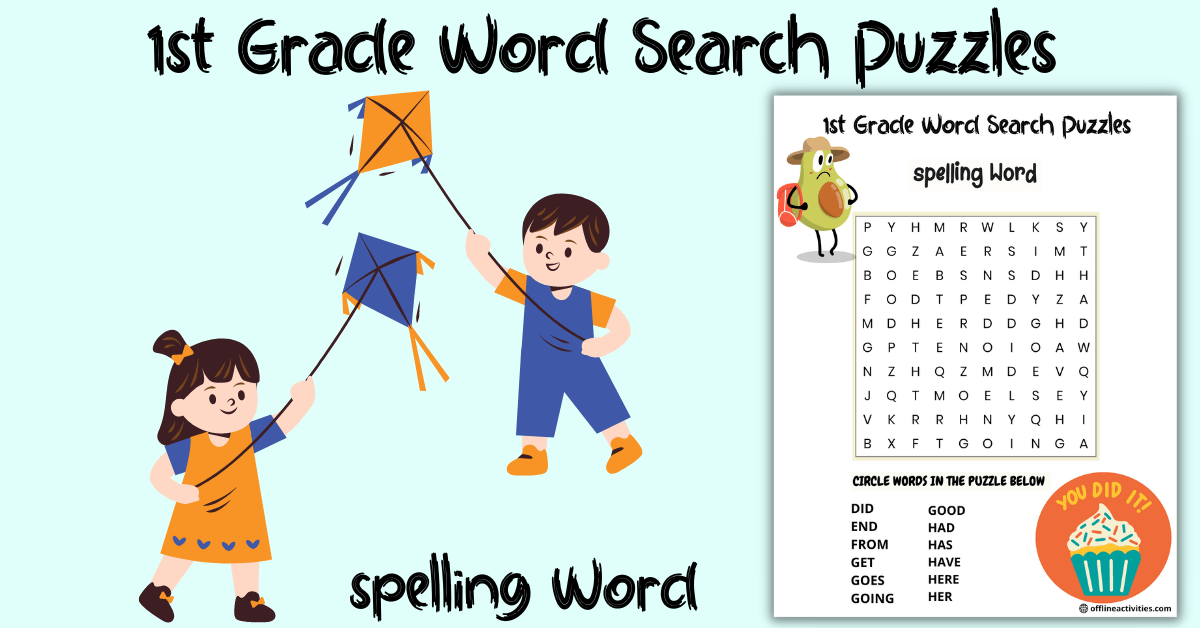
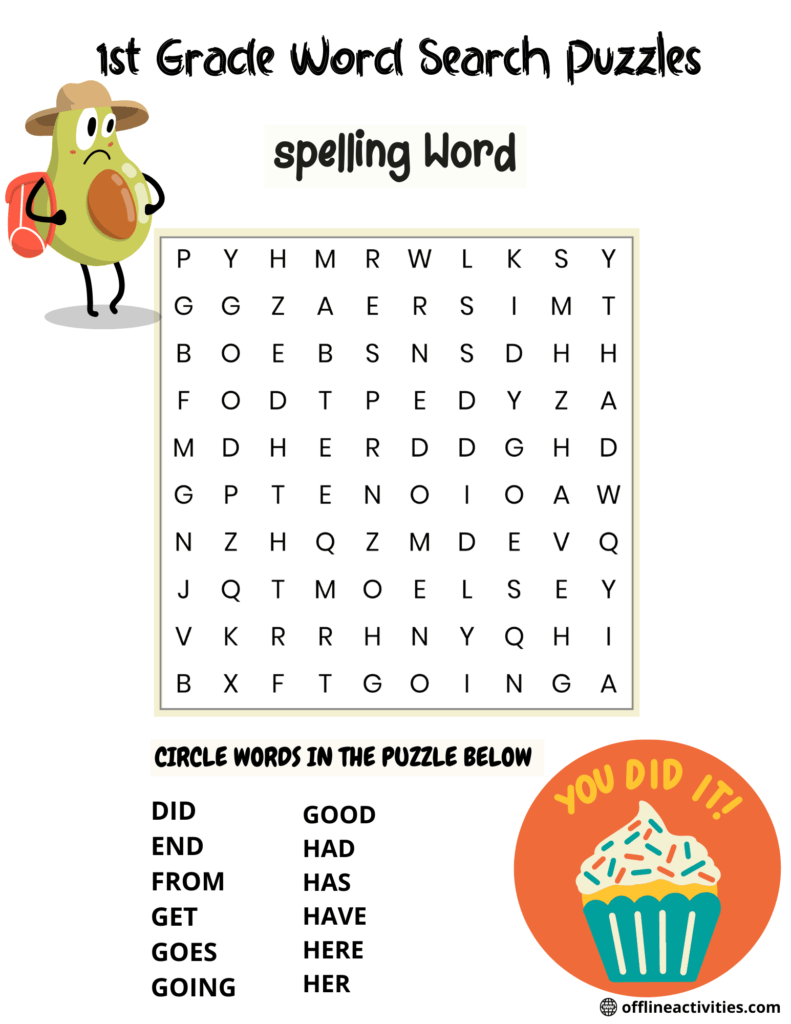
If you walked into our classroom during literacy centers, you might hear a gentle hum of focused activity. But one corner is often completely silent, occupied by children working on our first grade sight word search puzzles. What looks like simple fun is actually a sophisticated learning tool in action. I’ve watched children who shy away from reading aloud lean confidently into these puzzles, their fingers tracing letters with purpose. This particular printable, featuring words like “HERE,” “FROM,” and “GOING,” transforms essential word recognition practice into a self-paced mission where every child can experience the thrill of discovery on their own terms.
Why This Learning Activity Builds Strong Readers
Word searches for early learners are a masterclass in integrated skill development. As children search for high-frequency words, they aren’t just playing—they’re cementing orthographic mapping, the mental process that turns letter sequences into instantly recognizable sight words. This is the foundation of reading fluency.
The activity also sharpens visual tracking abilities, training young eyes to move systematically across a page—a direct precursor to smooth reading. The fine motor control needed to circle words supports pencil grip development. By offering this practice screen-free, we protect the deep, uninterrupted focus necessary for cognitive encoding. Educational research consistently shows that tactile, self-paced activities like this promote stronger neural connections and better long-term retention than passive digital consumption.
Print Puzzle
Your Guide to a Successful Learning Session
Introducing this activity with intention sets the stage for a positive, productive experience. Here’s how to make the most of this printable resource.
Getting Started is Simple:
Download the high-quality PDF and print on standard paper. For a classroom-friendly, reusable option, place the sheet in a clear plastic sleeve. Students can then use dry-erase markers, allowing for repeated practice and making clean-up effortless.
Creating a Supportive Environment:
Begin by reviewing the word list together, paying special attention to similar words like “HAS,” “HAD,” and “HAVE.” Connect each word to its meaning with a quick example. Then, demonstrate by finding one word together. Show how to use the first and last letters as anchors. Your role is to be a calm facilitator. Use encouraging language that focuses on effort: “I appreciate how carefully you’re checking each letter,” or “Your persistence is helping you find tricky words.”
Adapting for Different Learners:
-
For Developing Readers: Start with just 5-6 concrete words like “DID,” “GET,” “HERE,” and “GOOD.” You can even circle the first letter of each target word in the grid to provide a helpful starting point.
-
For On-Track First Graders: Use the full puzzle as designed. To add a writing component, have children write each found word in a sentence on a separate sheet.
-
For Extended Challenge: Have students complete the puzzle without the word list, relying on memory. Or ask them to sort all found words by number of letters or vowel sounds.
Creative Extension Activities:
-
Story Weaving: After completing the puzzle, challenge children to create a short oral story using as many words as possible. “FROM HERE, I HAVE to GET GOING. I HAD a GOOD time!”
-
Word Categorization: Sort found words into groups: action words (GET, GOES, GOING), describing words (GOOD), and “helper” words (HERE, FROM, HAD).
-
Sound Matching: Identify all words with long ‘E’ sounds (HERE) or words that rhyme (DID, HAD).
The Educational Framework Behind the Fun
In my teaching practice, I use word searches as diagnostic tools as much as learning activities. They allow me to observe which direction a child scans, whether they recognize word families, and how they handle frustration—all valuable data for personalized instruction.
From a cognitive development perspective, this activity engages executive functions like working memory (holding the word in mind while searching) and cognitive flexibility (adjusting search strategies). It strengthens visual processing speed, a key component of reading fluency that’s rarely targeted directly in standard curriculum.
This approach aligns with constructivist learning theory, where children build understanding through direct experience. It embodies kinesthetic learning principles by engaging both visual and motor systems. Parents and teachers can trust this resource as a safe, pedagogically sound alternative to screen time that directly supports classroom learning objectives.
Learning Modalities Compared: Printable vs Digital Word Games
| Learning Dimension | Printable Word Search | Digital Word Game |
|---|---|---|
| Cognitive Engagement | Requires self-initiated strategy and sustained mental effort | Often features automated hints and rewards that reduce cognitive load |
| Visual Health | Provides a break from blue light and close screen focus | Contributes to digital eye strain with prolonged use |
| Motor Skill Development | Develops fine motor control through precise circling motions | Limited to tapping or swiping movements |
| Learning Environment | Can be used anywhere, fosters calm focus and conversation | Often isolates users with headphones and individual screens |
| Memory Formation | Physical engagement with paper creates stronger memory pathways | Digital interfaces may create more transient learning experiences |
Frequently Asked Questions
What specific reading skills does this activity develop?
This puzzle strengthens sight word recognition, visual discrimination, letter sequence awareness, and left-to-right tracking—all fundamental skills for emerging readers.
Can this be used with children who have learning differences?
Yes, the self-paced nature and visual format make it accessible for many learners. For children with visual processing challenges, try using a colored overlay or enlarging the print.
How can I incorporate this into a busy classroom schedule?
These puzzles work well as morning work, transition activities, literacy station tasks, or quiet work for early finishers. The consistent format means students can work independently once familiar with the activity.
What’s the optimal session length for this activity?
For first graders, 10-15 minutes of focused work is ideal. The goal is quality engagement rather than completion. Children can return to unfinished puzzles later in the day.
How does this support the science of reading?
It aligns with the orthographic mapping component by reinforcing the connection between a word’s pronunciation, meaning, and letter sequence through repeated visual exposure.
Can this activity be made collaborative?
Absolutely! Partner work encourages discussion and peer teaching. Children can take turns finding words or work together on more challenging searches.
Are there seasonal versions of these puzzles?
We create themed variations throughout the year that maintain the same educational value while incorporating seasonal vocabulary and interests.
Fostering Independent, Confident Learners
The most significant outcome of activities like this first grade word search isn’t merely the words learned—it’s the learning disposition cultivated. Children develop patience, build problem-solving resilience, and experience the satisfaction of self-directed accomplishment. These intangible benefits form the foundation of a positive relationship with learning that extends far beyond the classroom.
Download this sight word search printable and discover how a simple piece of paper can become a powerful tool for building confident, capable readers. It’s an invitation to create moments of peaceful, purposeful learning that children will carry with them long after the last word is circled.
MORE PUZZLES FOR YOU:
1st Grade Word Search Puzzles- Friends

Word Search Printable- First Grade Words

Word Find Search- Friends
