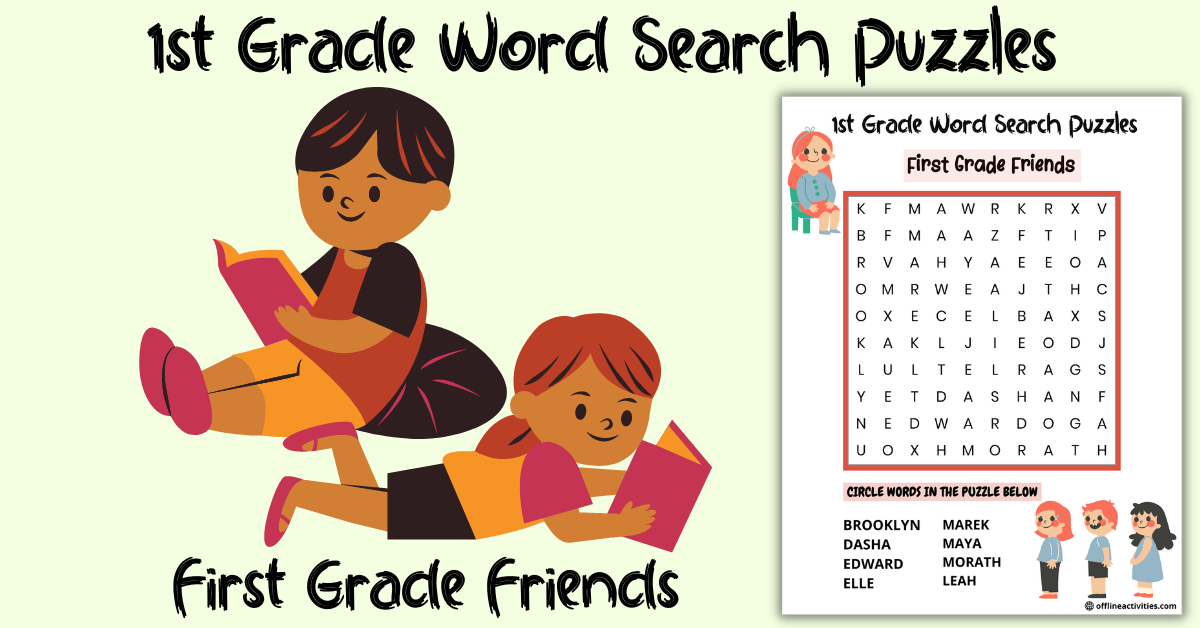
Have you ever watched your child struggle to connect with a new classmate because they hesitated over a name? Or noticed that after a long day of screens, their focus seems scattered, making it hard to practice those all-important early reading skills? You’re not alone. This printable “First-Grade Friends” Word Search is designed to bridge that gap. It turns the essential skill of name recognition into a joyful, screen-free game that builds classroom community, reinforces letter sounds, and gives your child a tangible boost of confidence. Let’s explore how this simple activity can foster connection and foundational literacy, one friend’s name at a time.
Why This Activity Works
This isn’t just a standard word search. It’s a social-emotional and phonics tool disguised as a puzzle.
-
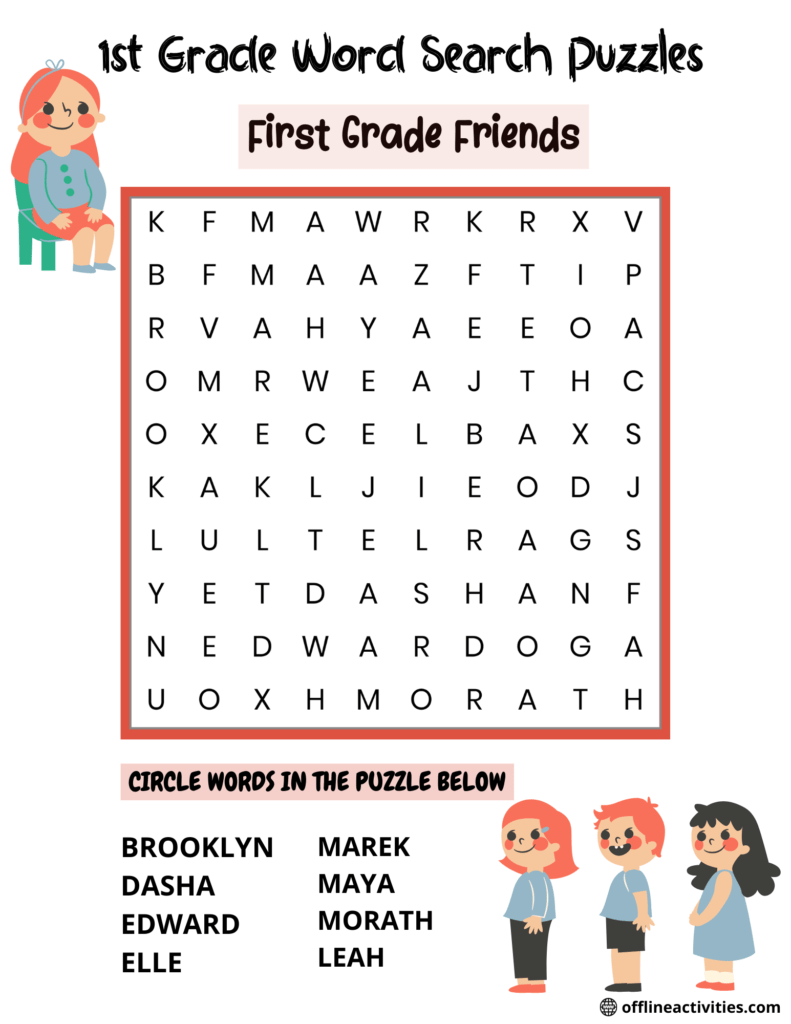
Builds Social Vocabulary & Community: Learning to read and recognize peers’ names (like BROOKLYN, MAYA, and EDWARD) is a first-grade milestone. It’s the first step in building a respectful, inclusive classroom environment where every child feels seen.
-
Reinforces Foundational Phonics: Searching for names requires children to identify beginning, middle, and ending sounds, strengthening their decoding skills. It turns abstract letters into meaningful words.
-
Develops Visual Discrimination & Focus: Scanning the grid for specific letter sequences sharpens pattern recognition and cultivates the sustained attention needed for reading.
-
Promotes Screen-Free Success: Completing a physical puzzle provides a clear, satisfying endpoint that passive screen time often lacks, building independence and a “I did it!” attitude.
A Quick Fact: Research indicates that activities requiring visual search and pattern recognition, like word searches, can actively improve the cognitive skills that are fundamental for learning to read.
🎁 Ready to Foster Friendship & Focus?
Download the “First-Grade Friends” Word Search !
Print Puzzle
Your Step-by-Step Guide to a Successful Name Hunt
Let’s turn this printable into an engaging, multi-skill learning session. Here’s how to guide your child or students for maximum benefit and fun.
1. Download, Print & Personalize
-
Get Your Free Copy: Download the high-resolution PDF using the link above. For best results, print on standard letter-size paper.
-
Create a Reusable Activity Center: Consider sliding the printed puzzle into a clear plastic sheet protector. Your child can use a dry-erase marker to circle names, allowing the same puzzle to be enjoyed again and again by different children or for repeated practice.
-
(You’ll need dry-erase markers and plastic sleeves to reuse this printable again and again, making it a lasting classroom or homeschool resource.)
-
2. Introducing the Activity: Frame it as a Friendship Mission
Gather your children and frame the activity positively. “We’re going on a detective mission to find all our friends hiding in this grid! Let’s read the list of names together first. Do you see your name? Do you see the name of someone you sit next to?” This immediately builds personal connection and relevance.
3. Guiding the Search & Adapting for Different Learners
-
For Emerging Readers (Ages 5-6): Focus on the first letter of each name. “MAREK starts with a big ‘M’. Can you find the ‘M’ in the grid? Let’s trace the letters that come after it together.” You can highlight the first letter of each name on the list for them.
-
For Developing Readers (Ages 6-7): Challenge them to find the names independently. Encourage them to say each letter sound softly as they scan. For longer names like BROOKLYN, you can clap the syllables first to break it down.
-
For Confident Readers (Age 7+): Time them for a friendly challenge, or have them find the names in alphabetical order. Ask them to find two names that share a common letter or sound.
4. Creative Extensions to Build Community & Skills
-
“Classmate Interview” Extension: After finding a name, encourage your child to share one nice thing about that friend. This builds social awareness. Use our bonus “All About Me” sheets (included in the Gumroad download) to take this further—kids can draw themselves and a friend they found in the puzzle.
-
Movement Break: Borrow a classic game from the playground! After five minutes of focused puzzle work, play a quick round of “Duck, Duck, Goose” to integrate the theme, get the wiggles out, and practice naming each other.
-
Phonics Sort: Once all names are found, work together to sort them. Which names start with the same sound (MAREK and MAYA)? Which end with the same letter? This is a powerful Montessori-inspired activity that moves from concrete (finding the word) to abstract (analyzing its sounds).
The Educational Context: More Than Just a Game
Experience: In my classroom sessions, I’ve seen this simple activity work wonders. Children who are often shy light up when they find their own name, and the collaborative “I found ELLE!” moments naturally spark conversations and peer assistance.
Expertise: This activity engages multiple linguistic domains: visual recognition (seeing the name), phonological processing (sounding it out), and semantic meaning (connecting the word to a real person). It’s a classic example of active learning, where the child is the agent in their discovery process.
Authority: The approach aligns with Montessori and play-based learning philosophies, which stress that meaningful, contextual vocabulary is learned best. Learning peers’ names isn’t just reading; it’s a foundational social skill that fosters a positive learning environment.
Trustworthiness: The activity is inherently safe and inclusive. The names chosen are common and culturally diverse, allowing many children to see themselves reflected. The instructions are clear and promote positive interaction.
Word Search vs. Screen Games: Which Builds Social & Academic Skills?
| Feature | “First-Grade Friends” Printable Word Search | Typical Tablet Learning Game |
|---|---|---|
| Social & Emotional Skill | Directly builds community by using peer names; encourages conversation. | Often isolated play; social elements are usually virtual or competitive. |
| Cognitive Focus | Sustained, deep visual search across a static field, building patience and attention to detail. | Focus is often fragmented by rewards, ads, or rapid scene changes. |
| Learning Context | Tactile, self-paced, and collaborative. Easy to do with a friend or as a group. | Typically screen-bound, passive, and individual. |
| Outcome | Tangible accomplishment (a completed puzzle) that can be displayed; skills transfer directly to reading books and class lists. | Digital reward (points, badges); skills may not transfer as effectively to offline tasks. |
Frequently Asked Questions (FAQ)
Q: What age is this “First-Grade Friends” word search for?
A: It’s ideally suited for children aged 5-7, typically in Kindergarten through early 2nd grade. Younger learners will benefit from guided help focusing on first letters, while older children can complete it independently as a community-building exercise.
Q: Can I use these printables in my classroom?
A: Absolutely! They are perfect for morning work, literacy centers, quiet time activities, or as a welcome activity at the start of the school year to help students learn each other’s names. We encourage teachers to download and use them.
Q: How can I make this activity more fun for a child who finds it challenging?
A: Turn it into a team effort! Work on it together, taking turns. Use a highlighter instead of a pencil for easier marking. Focus on finding just 2-3 names to start, celebrating each success. You can also point to a section of the grid to narrow the search area.
Q: My child already knows how to read these names. Is it still useful?
A: Yes! For a fluent reader, it becomes a speed and observation challenge. You can extend the learning by having them use the names in sentences, sort them by syllable count, or even create a rhyming word for each one. The bonus “All About Me” sheets add a creative writing component.
Q: Where can I find more themed word searches like this?
A: By downloading this free pack, you’re joining our community focused on meaningful, screen-free learning. We regularly share new thematic printables that blend academic skills with social-emotional learning.
Conclusion: Building the Foundation for a Love of Learning
This free printable puzzle does more than fill time. It weaves together the essential threads of early education: literacy, focus, and human connection. Every name found is a small victory in letter recognition; every shared moment over the puzzle strengthens the classroom and family bond.
Every name discovered builds not just reading skills—but a sense of belonging and confidence too.
📚 Start Your Classroom’s Connected Learning Journey Today!
Download the FREE “First-Grade Friends” Word Search Now. You’ll get instant access to this community-building activity and extensions to nurture both academic and social growth. Let’s make learning names a joyful first step toward a great school year!
MORE PUZZLES FOR YOU:
1st Grade Word Search Puzzles- Friends

Puzzle Find a Word- Spelling Word
Free Game of Word Search- Spelling Words